>
Gonorynchiformes (Milkfishes) >
Phractolaemidae (Hingemouths)
Etymology: Phractolaemus: Greek, phraktos = fence + Greek, laimos = throttle (Ref. 45335).
Eponymy: Dr William John Ansorge (1850–1913) was an English explorer and collector who was active in Africa in the second half of the 19th century. [...] (Ref. 128868), visit book page.
More on author: Boulenger.
Lingkungan: lingkungan / zona iklim / kisaran kedalaman / jangkauan distribusi
Ekologi
; air tawar bentopelagis; pH range: 6.0 - 8.0; dH range: ? - 25. Tropical; 25°C - 30°C (Ref. 13371)
Africa: in West Africa from Lake Nokoué (Ouémé River, Benin) (Ref. 81277) to Cross River (Cameroon) (Ref. 52397), including Ogun, Osse and Niger Delta (Ref. 81277). Also in the middle Congo River basin (Ref. 93183) in Republic of Congo and Democratic Republic of the Congo.
Ukuran / Berat / umur
Kematangan: Lm ? range ? - ? cm
Max length : 25.0 cm TL jantan/; (Ref. 93183)
deskripsi pendek
Kunci identifiaksi (pengenalan) | Morfologi | Morfometrik
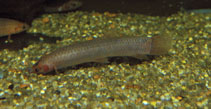
Duri punggung (Keseluruhan (total)) : 0; duri punggung lunak (Keseluruhan (total)) : 6; Duri dubur: 0; Sirip dubur lunak: 6; vertebrata, bertulang belakang: 34 - 38. Diagnosis: head depressed and strongly ossified; anterior nostril elongate, forming an oblique, forward-pointing tube; posterior nostril crescent-shaped, located just behind the narial tube (Ref. 2913, 81277). Mouth small, protrusible (Ref. 245, 31256, 81277), placed at tip of a proboscis and opening upwards between the narial tubes (Ref. 2913, 81277), on upper surface of snout (Ref. 245, 31256). Narrow gill opening, but opercles very well developed, covering also the underside of the head where they overlap (Ref. 2913, 81277, 93183).
Body shape (shape guide): elongated; Cross section: circular.
Facultative or obligate air-breathing (Ref. 126274); Lives in forest pools and swamps (Ref. 41580). Microphagous (Ref. 4910, 41580, 45483), especially phytophagous (epiphytes), and detritiphagous (Ref. 41580). Swim bladder entirely alveolar, functioning like a lung; this adaptation to aerial breathing allows the fish to survive under poor oxygenation conditions (Ref. 2913, 81277); recorded from nearly deoxygenated lungfish nest in Pool Malebo, Congo DR (Ref. 41585). Gonads, which are largely fused, are situated ventrally, not dorsally, in abdominal cavity (Ref. 41580). Mouth can be projected as a small trunk (Ref. 2913). Eggs transparent, yellow-greenish, 1.5-1.7mm diameter; large females may have several thousands of eggs (Ref. 41580). Particular blood system, with dark coloured and an abundant amouth of blood (Ref. 4910).
Males and females have lateral tubercles on their body which probably aid in maintaining contact during spawning (Ref. 38266).
Lévêque, C., 1990. Phractolaemidae. p. 189-191. In C. Lévêque, D. Paugy and G.G. Teugels (eds.) Faune des poissons d'eaux douces et saumâtres d'Afrique de l'Ouest. Tome I. Coll. Faune Tropicale n° XXVIII. Musée Royal de l'Afrique Centrale, Tervuren, and O.R.S.T.O.M.,Paris, 384 p. (Ref. 2913)
Status IUCN Red List (Ref. 130435: Version 2025-2 (Global))
ancaman kepada manusia
Harmless
penggunaan manusia
Alat, peralatan
laporan khas
muat turun XML
Sumber internet
Estimasi berdasarkan model
Indeks keanekaragaman filogenetik (Acuan
82804): PD
50 = 1.5000 [Uniqueness, from 0.5 = low to 2.0 = high].
Bayesian length-weight: a=0.00437 (0.00168 - 0.01136), b=3.13 (2.90 - 3.36), in cm total length, based on LWR estimates for this (Sub)family-body shape (Ref.
93245).
Tingkat Trofik (Acuan
69278): 2.3 ±0.1 se; based on diet studies.
Kerentanan Penangkapan Ikan (Ref.
59153): Low vulnerability (15 of 100).
🛈