Elasmobranquios (tiburones y rayas) (sharks and rays) >
Rajiformes (Skates and rays) >
Rajidae (Skates)
Etymology: Dactylobatus: Greek, daktyleys, -eos = a kind of grey mullet + Greek, batis = a kind of ray (Ref. 45335); armatus: dáctylos, Greek, means finger or fin-ray; bátis mean ray. Latin armatus means armed.
Entorno: milieu / zona climática / rango de profundidad / gama de distribución
Ecología
marino batidemersal; rango de profundidad 300 - 900 m (Ref. 80663), usually 300 - 700 m (Ref. 80663). Deep-water; 35°N - 35°S, 30°W - 98°W
Western Central Atlantic: South Carolina, USA to the Gulf of Mexico and along Central America to Venezuela. Also found on middle continental slope off southern Brazil.
Tamaño / Peso / Edad
Madurez: Lm ? range ? - ? cm
Max length : 32.0 cm TL macho / no sexado; (Ref. 557)
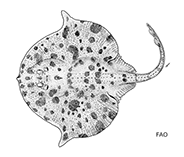
Narrow spatula-shaped lobe from margin of each pectoral. Upper surface ashy gray. Lower surface yellowish white, clouded with mouse gray (Ref. 6902). Characteristic spines on underside of frontal margin of disc.
Body shape (shape guide): other.
Moderately deep water species (Ref. 6902). Oviparous (Ref. 50449). Eggs have horn-like projections on the shell (Ref. 205).
Ciclo vital y comportamiento de apareamiento
Madurez | Reproducción | Puesta | Huevos | Fecundidad | Larva
Oviparous, paired eggs are laid. Embryos feed solely on yolk (Ref. 50449). Eggs have horn-like projections on the shell (Ref. 205).
McEachran, J.D. and K.A. Dunn, 1998. Phylogenetic analysis of skates, a morphologically conservative clade of elasmobranchs (Chondrichthyes: Rajidae). Copeia 1998(2):271-290. (Ref. 27314)
Situación en la Lista Roja de la UICN (Ref. 130435: Version 2025-2 (Global))
Amenaza para el ser humano
Harmless
Usos humanos
Pesquerías: sin interés
Herramientas
Informes especiales
Descargar XML
Fuentes de Internet
Estimaciones basadas en modelos
Índice de diversidad filogenética (Referencia
82804): PD
50 = 0.7500 [Uniqueness, from 0.5 = low to 2.0 = high].
Bayesian length-weight: a=0.00302 (0.00141 - 0.00645), b=3.24 (3.07 - 3.41), in cm total length, based on LWR estimates for this (Sub)family-body shape (Ref.
93245).
Nivel trófico (Referencia
69278): 3.6 ±0.5 se; based on size and trophs of closest relatives
Resiliencia (Referencia
120179): Bajo, población duplicada en un tiempo mínimo de 4.5-14 años (Fec assumed to be <100).
Vulnerabilidad pesquera (Ref.
59153): Low vulnerability (22 of 100).
🛈