Élasmobranches (requins et raies) (sharks and rays) >
Rajiformes (Skates and rays) >
Rajidae (Skates)
Etymology: Dactylobatus: Greek, daktyleys, -eos = a kind of grey mullet + Greek, batis = a kind of ray (Ref. 45335); armatus: dáctylos, Greek, means finger or fin-ray; bátis mean ray. Latin armatus means armed.
Environnement : milieu / zone climatique / profondeur / gamme de distribution
Écologie
marin bathydémersal; profondeur 300 - 900 m (Ref. 80663), usually 300 - 700 m (Ref. 80663). Deep-water; 35°N - 35°S, 30°W - 98°W
Western Central Atlantic: South Carolina, USA to the Gulf of Mexico and along Central America to Venezuela. Also found on middle continental slope off southern Brazil.
Taille / Poids / Âge
Maturité: Lm ? range ? - ? cm
Max length : 32.0 cm TL mâle / non sexé; (Ref. 557)
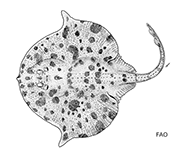
Narrow spatula-shaped lobe from margin of each pectoral. Upper surface ashy gray. Lower surface yellowish white, clouded with mouse gray (Ref. 6902). Characteristic spines on underside of frontal margin of disc.
Body shape (shape guide): other.
Moderately deep water species (Ref. 6902). Oviparous (Ref. 50449). Eggs have horn-like projections on the shell (Ref. 205).
Cycle de vie et comportement reproducteur
Maturité | Reproduction | Frai | Œufs | Fécondité | Larves
Oviparous, paired eggs are laid. Embryos feed solely on yolk (Ref. 50449). Eggs have horn-like projections on the shell (Ref. 205).
McEachran, J.D. and K.A. Dunn, 1998. Phylogenetic analysis of skates, a morphologically conservative clade of elasmobranchs (Chondrichthyes: Rajidae). Copeia 1998(2):271-290. (Ref. 27314)
Statut dans la liste rouge de l'IUCN (Ref. 130435: Version 2025-2 (Global))
Menace pour l'homme
Harmless
Utilisations par l'homme
Pêcheries: sans intérêt
Outils
Articles particuliers
Télécharger en XML
Sources Internet
Estimations basées sur des modèles
Indice de diversité phylogénétique (Réf.
82804): PD
50 = 0.7500 [Uniqueness, from 0.5 = low to 2.0 = high].
Bayesian length-weight: a=0.00302 (0.00141 - 0.00645), b=3.24 (3.07 - 3.41), in cm total length, based on LWR estimates for this (Sub)family-body shape (Ref.
93245).
Niveau trophique (Réf.
69278): 3.6 ±0.5 se; based on size and trophs of closest relatives
Résilience (Réf.
120179): Faible, temps minimum de doublement de population : 4,5 à 14 années (Fec assumed to be <100).
Vulnérabilité de la pêche (Ref.
59153): Low vulnerability (22 of 100).
🛈