>
Siluriformes (Catfishes) >
Bagridae (Bagrid catfishes)
Etymology: Mystus: Greek, mystax = whiskered, used by Belon in 1553 to describe all fishes with whiskers (Ref. 45335).
More on author: Hamilton.
Περιβάλλον: περιβάλλον / κλιματική ζώνη / εύρος βάθους / εύρος διανομής
Οικολογία
; Γλυκού νερού; Υφάλμυρο βενθικό(ς); αμφίδρομο (Ref. 51243). Tropical; 5°N - 38°S
Asia: lowland rivers in most major basins of the Indian subcontinent (Pakistan, Nepal, India, Sri Lanka and Myanmar), including but not limited to the Indus, Brahmaputra-Ganges, Krishna, Cauvery, Irrawaddy, Salween and Tenasserim. Reports of this species from the Chao Phraya and Mekong basins, Malaysia, and Indonesia are based on misidentifications of Mystus albolineatus or Mystus singaringan. Occurs in Thailand, but only in the Salween basin.
Μέγεθος / Βάρος / Ηλικία
Γεννητική Ωρίμανση: Lm ? range ? - ? cm
Max length : 40.0 cm SL αρσενικό/απροσδιόριστο; (Ref. 4833); μεγ. δημοσιευμένο βάρος: 10.0 kg (Ref. 4833)
Σύντομη περιγραφή
Κλείδες προσδιορισμού | Μορφολογία | Μορφομετρία
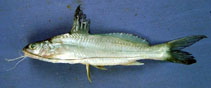
Ραχιαίες άκανθες (συνολικά) : 1; Μαλακές ραχιαίες ακτίνες (συνολικά) : 7; Εδρικές άκανθες: 0; Μαλακές εδρικές ακτίνες: 10 - 11. Body elongate and compressed; head conical; occipital process narrow. Maxillary barbels, in adults, extend posteriorly beyond the caudal fin base, but in young specimen, do not extend beyond the anal fin. Dorsal spine weak, often feebly serrated. Color is grayish with a more or less well-defined midlateral longitudinal stripe. A dark spot emphasized by a white or pale area along its ventral margin is just anterior to the first dorsal spine. Dorsal, adipose and caudal fins shaded with melanophores.
Body shape (shape guide): elongated; Cross section: oval.
Facultative air-breathing (Ref. 126274); Found in tidal rivers and lakes; also beels, canals, ditches, ponds, and inundated fields. Its pectoral spine can cause painful wounds (Ref. 4833). Found in the basin-wide tributary of the lower Mekong (Ref. 36667). Oviparous, distinct pairing possibly like other members of the same family (Ref. 205).
Κύκλος ζωής και συμπεριφορά ζευγαρώματος
Γεννητική Ωρίμανση | Αναπαραγωγή | Γεννοβολία | Αβγά | Γονιμότητα | Προνύμφες
Talwar, P.K. and A.G. Jhingran, 1991. Inland fishes of India and adjacent countries. Volume 2. A.A. Balkema, Rotterdam, i-xxii + 543-1158, 1 pl. (Ref. 4833)
Κατάσταση Κόκκινου Καταλόγου IUCN (Ref. 130435: Version 2025-2 (Global))
Ανθρώπινες χρήσεις
αλιεία: Εμπορικό(ά)
Εργαλεία
Ειδικές εκθέσεις
Λήψη XML
Διαδικτυακές πηγές
Εκτιμήσεις βάσει μοντέλων
Δείκτης φυλογενετικής ποικιλότητας (Αναφ.
82804): PD
50 = 0.5000 [Uniqueness, from 0.5 = low to 2.0 = high].
Bayesian length-weight: a=0.00912 (0.00752 - 0.01106), b=2.95 (2.91 - 2.99), in cm total length, based on LWR estimates for this species (Ref.
93245).
Τροφικό Επίπεδο (Αναφ.
69278): 3.4 ±0.4 se; based on size and trophs of closest relatives
Ελαστικότητα (Αναφ.
120179): Μεσαίο(α), ελάχιστος χρόνος για διπλασιασμό πληθυσμού 1,4 - 4,4 έτη (Fec = 3,314).
Ευπάθεια στην αλιεία (Ref.
59153): Moderate vulnerability (39 of 100).
🛈
Θρεπτικά συστατικά (Ref.
124155): Calcium = 231 [118, 431] mg/100g; Iron = 2.13 [1.21, 3.62] mg/100g; Protein = 16.2 [15.2, 17.2] %; Omega3 = 0.165 [0.085, 0.302] g/100g; Selenium = 56.4 [28.9, 116.2] μg/100g; VitaminA = 17.9 [5.9, 51.0] μg/100g; Zinc = 1.53 [0.98, 2.31] mg/100g (wet weight); based on
nutrient studies.