>
Siluriformes (Catfishes) >
Bagridae (Bagrid catfishes)
Etymology: Mystus: Greek, mystax = whiskered, used by Belon in 1553 to describe all fishes with whiskers (Ref. 45335).
More on author: Hamilton.
Environnement : milieu / zone climatique / profondeur / gamme de distribution
Écologie
; eau douce; saumâtre démersal; amphidrome (Ref. 51243). Tropical; 5°N - 38°S
Asia: lowland rivers in most major basins of the Indian subcontinent (Pakistan, Nepal, India, Sri Lanka and Myanmar), including but not limited to the Indus, Brahmaputra-Ganges, Krishna, Cauvery, Irrawaddy, Salween and Tenasserim. Reports of this species from the Chao Phraya and Mekong basins, Malaysia, and Indonesia are based on misidentifications of Mystus albolineatus or Mystus singaringan. Occurs in Thailand, but only in the Salween basin.
Taille / Poids / Âge
Maturité: Lm ? range ? - ? cm
Max length : 40.0 cm SL mâle / non sexé; (Ref. 4833); poids max. publié: 10.0 kg (Ref. 4833)
Description synthétique
Clés d'identification | Morphologie | Morphométrie
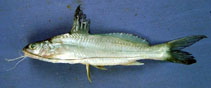
Épines dorsales (Total) : 1; Rayons mous dorsaux (Total) : 7; Épines anales: 0; Rayons mous anaux: 10 - 11. Body elongate and compressed; head conical; occipital process narrow. Maxillary barbels, in adults, extend posteriorly beyond the caudal fin base, but in young specimen, do not extend beyond the anal fin. Dorsal spine weak, often feebly serrated. Color is grayish with a more or less well-defined midlateral longitudinal stripe. A dark spot emphasized by a white or pale area along its ventral margin is just anterior to the first dorsal spine. Dorsal, adipose and caudal fins shaded with melanophores.
Body shape (shape guide): elongated; Cross section: oval.
Facultative air-breathing (Ref. 126274); Found in tidal rivers and lakes; also beels, canals, ditches, ponds, and inundated fields. Its pectoral spine can cause painful wounds (Ref. 4833). Found in the basin-wide tributary of the lower Mekong (Ref. 36667). Oviparous, distinct pairing possibly like other members of the same family (Ref. 205).
Cycle de vie et comportement reproducteur
Maturité | Reproduction | Frai | Œufs | Fécondité | Larves
Talwar, P.K. and A.G. Jhingran, 1991. Inland fishes of India and adjacent countries. Volume 2. A.A. Balkema, Rotterdam, i-xxii + 543-1158, 1 pl. (Ref. 4833)
Statut dans la liste rouge de l'IUCN (Ref. 130435: Version 2025-2 (Global))
Utilisations par l'homme
Pêcheries: commercial
Outils
Articles particuliers
Télécharger en XML
Sources Internet
Estimations basées sur des modèles
Indice de diversité phylogénétique (Réf.
82804): PD
50 = 0.5000 [Uniqueness, from 0.5 = low to 2.0 = high].
Bayesian length-weight: a=0.00912 (0.00752 - 0.01106), b=2.95 (2.91 - 2.99), in cm total length, based on LWR estimates for this species (Ref.
93245).
Niveau trophique (Réf.
69278): 3.4 ±0.4 se; based on size and trophs of closest relatives
Résilience (Réf.
120179): Milieu, temps minimum de doublement de population : 1,4 à 4,4 années (Fec = 3,314).
Vulnérabilité de la pêche (Ref.
59153): Moderate vulnerability (39 of 100).
🛈
Nutriments (Ref.
124155): Calcium = 231 [118, 431] mg/100g; Iron = 2.13 [1.21, 3.62] mg/100g; Protein = 16.2 [15.2, 17.2] %; Omega3 = 0.165 [0.085, 0.302] g/100g; Selenium = 56.4 [28.9, 116.2] μg/100g; VitaminA = 17.9 [5.9, 51.0] μg/100g; Zinc = 1.53 [0.98, 2.31] mg/100g (wet weight); based on
nutrient studies.