Milieu: milieu / Klimaatzone / Diepte / verspreidingsgebied
Ecologie
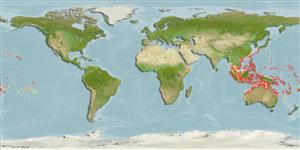
marien rifbewoner; standvastig; diepte 1 - 50 m (Ref. 1602). Tropical; 32°N - 32°S, 96°E - 136°W
Eastern Central Indian Ocean to Western Pacific: : Cocos-Keeling Islands in the eastern Indian Ocean to Samoa and the Line Islands, north to southern Japan, south to Rowley Shoals (eastern Indian Ocean) and Lord Howe Island (Ref. 37816). Not found in the Hawaiian and Society islands and islands beyond. Replaced by Dascyllus carneus in the Indian Ocean (Ref. 37816).
Grootte / Gewicht / Leeftijd
Maturiteit: Lm ? range ? - ? cm
Max length : 9.0 cm TL mannelijk / geslacht onbekend; (Ref. 30874)
Korte beschrijving
Determinatiesleutels | Morfologie | Morfometrie
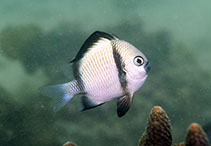
Dorsale stekels (totaal) : 12; Dorsale zachte stralen (totaal) : 14 - 16; Anale stekels: 2; Anale zachte stralen: 12 - 14. Color variable according to ecological and behavioral conditions: basically body whitish with snout, interorbital and forehead greenish; black bar on anterior and a fainter one on posterior part of the body; blackish scale margins; pelvic fins mostly black; pectorals transparent with a spot on its base. Margins of preorbital, suborbital, and preoperculum finely serrated (Ref. 2746). Body depth 1.4-1.6 in SL (Ref. 90102).
Body shape (shape guide): short and / or deep; Cross section: compressed.
Adults occur in outer lagoon and seaward reefs. They inhabit branching coral heads, particularly Pocillopora eydouxi. Form schools, often in silty habitats (Ref. 48636). Male prepares a nest by cleaning with its mouth a rock or coral surface where the female will attach the eggs (Ref. 5503). Oviparous, distinct pairing during breeding (Ref. 205). Diurnal species (Ref. 54980; 113699).
Levenscyclus en paargedrag
Maturiteit | Voortplanting | Paaien | Eieren | Fecunditeit | Larven
Benthic spawner. Oviparous, distinct pairing during breeding (Ref. 205). Eggs are demersal and adhere to the substrate (Ref. 205). Males guard and aerate the eggs (Ref. 205). Also Ref. 103751.
Randall, H.A. and G.R. Allen, 1977. A revision of the damselfish genus Dascyllus (Pomacentridae) with description of a new species. Rec. Aust. Mus. 31(9):349-385. (Ref. 2746)
Status op de Rode Lijst van het IUCN (Ref. 130435: Version 2025-2 (Global))
Gevaar voor de mens
Harmless
Gebruik door de mens
Visserij: van minder commercieel belang; Aquarium: Commercieel
Tools
Speciale rapporten
Download XML
Internetbronnen
Schattingen op basis van modellen
Gewenste temperatuur (Ref.
123201): 24.6 - 28.9, mean 27.6 °C (based on 448 cells).
Fylogenetische diversiteitsindex (Ref.
82804): PD
50 = 0.5005 [Uniqueness, from 0.5 = low to 2.0 = high].
Bayesian length-weight: a=0.02951 (0.01702 - 0.05118), b=2.99 (2.84 - 3.14), in cm total length, based on LWR estimates for this species & (Sub)family-body (Ref.
93245).
Trofisch niveau (Ref.
69278): 3.1 ±0.31 se; based on food items.
Generation time: 2.1 ( na - na) years. Estimated as median ln(3)/K based on 1
growth studies.
Weerstandsvermogen (Ref.
120179): Hoog, minimale populatieverdubbelingstijd minder dan 15 maanden (K=0.5).
Kwetsbaarheid van de visserij (Ref.
59153): Low vulnerability (25 of 100).
🛈
Voedingsstoffen (Ref.
124155): Calcium = 113 [54, 184] mg/100g; Iron = 0.823 [0.485, 1.409] mg/100g; Protein = 18 [17, 19] %; Omega3 = 0.126 [0.070, 0.219] g/100g; Selenium = 23.5 [11.4, 48.6] μg/100g; VitaminA = 181 [49, 646] μg/100g; Zinc = 1.6 [1.0, 2.3] mg/100g (wet weight);