Entorno: milieu / zona climática / rango de profundidad / gama de distribución
Ecología
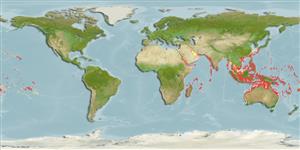
marino asociado a arrecife; no migratorio; rango de profundidad 0 - 55 m (Ref. 7247). Tropical; 32°N - 36°S, 24°E - 128°W
Indo-Pacific: Red Sea and East Africa to the Line and Pitcairn islands, north to southern Japan, south to Sydney, Australia. Not found in the Hawaiian and Marquesan islands.
Tamaño / Peso / Edad
Madurez: Lm ? range ? - ? cm
Max length : 14.0 cm TL macho / no sexado; (Ref. 89972); peso máximo publicado: 45.21 g (Ref. 126022)
Descripción breve
Claves de identificación | Morfología | Morfometría
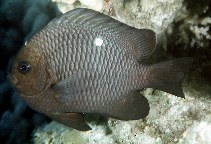
Espinas dorsales (total) : 12; Radios blandos dorsales (total) : 14 - 16; Espinas anales: 2; Radios blandos anales: 14 - 15. Juveniles overall black with scale centers bluish; white blotch on forehead and upper sides; all fins black except the transparent pectoral and outer portion of soft dorsal rays. Geographic and behavioral color of adults variable; no spot on forehead; spot on upper sides very reduced; head and fins normally black; scales with black margins. Margins of preorbital, suborbital and preoperculum finely serrated (Ref. 2746). Nuptial fish generally paler color. Body depth 1.4-1.6 in SL (Ref. 90102).
Body shape (shape guide): short and / or deep; Cross section: compressed.
Adults inhabit coral and rocky reefs, juveniles often commensal with large sea anemones, sea urchins, or small coral heads (Ref. 4391, 48636). They occur in small to large aggregations. Stomach contents include algae, copepods, and other planktonic crustaceans (Ref. 7247). Oviparous, distinct pairing during breeding (Ref. 205). Eggs are demersal and adhere to the substrate (Ref. 205). Males guard and aerate the eggs (Ref. 205). Diurnal species (Ref. 54980; 120737). Minimum depth reported taken from Ref. 128797.
Ciclo vital y comportamiento de apareamiento
Madurez | Reproducción | Puesta | Huevos | Fecundidad | Larva
Oviparous, distinct pairing during breeding (Ref. 205). Eggs are demersal and adhere to the substrate (Ref. 205). Males guard and aerate the eggs (Ref. 205). Courtship characterized by male 'signal-jumping'. Captive pair reported to spawn thrice monthly with a total of 17 over a 7-month period (Ref. 2856). While protogyny was originally proposed for this species, recent studies confirmed gonochorism in the form of non-functional hermaphroditism (Ref. 103751).
Allen, G.R., 1991. Damselfishes of the world. Mergus Publishers, Melle, Germany. 271 p. (Ref. 7247)
Situación en la Lista Roja de la UICN (Ref. 130435: Version 2025-2 (Global))
Amenaza para el ser humano
Harmless
Usos humanos
Pesquerías: escaso valor comercial; Acuario: Comercial
Herramientas
Informes especiales
Descargar XML
Fuentes de Internet
Estimaciones basadas en modelos
Temperatura preferida (Referencia
123201): 24.6 - 29, mean 28 °C (based on 1240 cells).
Índice de diversidad filogenética (Referencia
82804): PD
50 = 0.5005 [Uniqueness, from 0.5 = low to 2.0 = high].
Bayesian length-weight: a=0.03467 (0.02149 - 0.05594), b=2.93 (2.79 - 3.07), in cm total length, based on LWR estimates for this species & (Sub)family-body (Ref.
93245).
Nivel trófico (Referencia
69278): 3.0 ±0.24 se; based on food items.
Resiliencia (Referencia
120179): Alto, población duplicada en un tiempo mínimo inferior a 15 meses (Fec=20,000-25,000).
Vulnerabilidad pesquera (Ref.
59153): Low vulnerability (10 of 100).
🛈
Nutrientes (Ref.
124155): Calcium = 90.3 [45.4, 146.6] mg/100g; Iron = 0.802 [0.476, 1.335] mg/100g; Protein = 18 [17, 19] %; Omega3 = 0.115 [0.067, 0.193] g/100g; Selenium = 27.9 [13.9, 57.3] μg/100g; VitaminA = 123 [33, 443] μg/100g; Zinc = 1.48 [0.97, 2.15] mg/100g (wet weight);