Περιβάλλον: περιβάλλον / κλιματική ζώνη / εύρος βάθους / εύρος διανομής
Οικολογία
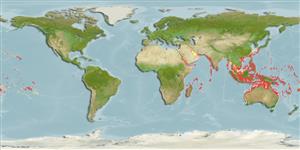
Θαλασσινό(ά) Υφαλόφιλο(α); μη μεταναστευτικό(ά); εύρος βάθους 0 - 55 m (Ref. 7247). Tropical; 32°N - 36°S, 24°E - 128°W
Indo-Pacific: Red Sea and East Africa to the Line and Pitcairn islands, north to southern Japan, south to Sydney, Australia. Not found in the Hawaiian and Marquesan islands.
Μέγεθος / Βάρος / Ηλικία
Γεννητική Ωρίμανση: Lm ? range ? - ? cm
Max length : 14.0 cm TL αρσενικό/απροσδιόριστο; (Ref. 89972); μεγ. δημοσιευμένο βάρος: 45.21 g (Ref. 126022)
Σύντομη περιγραφή
Κλείδες προσδιορισμού | Μορφολογία | Μορφομετρία
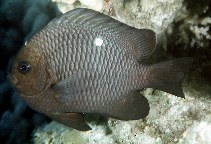
Ραχιαίες άκανθες (συνολικά) : 12; Μαλακές ραχιαίες ακτίνες (συνολικά) : 14 - 16; Εδρικές άκανθες: 2; Μαλακές εδρικές ακτίνες: 14 - 15. Juveniles overall black with scale centers bluish; white blotch on forehead and upper sides; all fins black except the transparent pectoral and outer portion of soft dorsal rays. Geographic and behavioral color of adults variable; no spot on forehead; spot on upper sides very reduced; head and fins normally black; scales with black margins. Margins of preorbital, suborbital and preoperculum finely serrated (Ref. 2746). Nuptial fish generally paler color. Body depth 1.4-1.6 in SL (Ref. 90102).
Body shape (shape guide): short and / or deep; Cross section: compressed.
Adults inhabit coral and rocky reefs, juveniles often commensal with large sea anemones, sea urchins, or small coral heads (Ref. 4391, 48636). They occur in small to large aggregations. Stomach contents include algae, copepods, and other planktonic crustaceans (Ref. 7247). Oviparous, distinct pairing during breeding (Ref. 205). Eggs are demersal and adhere to the substrate (Ref. 205). Males guard and aerate the eggs (Ref. 205). Diurnal species (Ref. 54980; 120737). Minimum depth reported taken from Ref. 128797.
Κύκλος ζωής και συμπεριφορά ζευγαρώματος
Γεννητική Ωρίμανση | Αναπαραγωγή | Γεννοβολία | Αβγά | Γονιμότητα | Προνύμφες
Oviparous, distinct pairing during breeding (Ref. 205). Eggs are demersal and adhere to the substrate (Ref. 205). Males guard and aerate the eggs (Ref. 205). Courtship characterized by male 'signal-jumping'. Captive pair reported to spawn thrice monthly with a total of 17 over a 7-month period (Ref. 2856). While protogyny was originally proposed for this species, recent studies confirmed gonochorism in the form of non-functional hermaphroditism (Ref. 103751).
Allen, G.R., 1991. Damselfishes of the world. Mergus Publishers, Melle, Germany. 271 p. (Ref. 7247)
Κατάσταση Κόκκινου Καταλόγου IUCN (Ref. 130435: Version 2025-2 (Global))
Απειλή για τον άνθρωπο
Harmless
Ανθρώπινες χρήσεις
αλιεία: περιορισμένης εμπορικότητας; Ενυδρείο: Εμπορικό(ά)
Εργαλεία
Ειδικές εκθέσεις
Λήψη XML
Διαδικτυακές πηγές
Εκτιμήσεις βάσει μοντέλων
Προτιμώμενη θερμοκρασία (Αναφ.
123201): 24.6 - 29, mean 28 °C (based on 1240 cells).
Δείκτης φυλογενετικής ποικιλότητας (Αναφ.
82804): PD
50 = 0.5005 [Uniqueness, from 0.5 = low to 2.0 = high].
Bayesian length-weight: a=0.03467 (0.02149 - 0.05594), b=2.93 (2.79 - 3.07), in cm total length, based on LWR estimates for this species & (Sub)family-body (Ref.
93245).
Τροφικό Επίπεδο (Αναφ.
69278): 3.0 ±0.24 se; based on food items.
Ελαστικότητα (Αναφ.
120179): Υψηλό, ελάχιστος χρόνος για διπλασιασμό πληθυσμού < 15 μήνες (Fec=20,000-25,000).
Ευπάθεια στην αλιεία (Ref.
59153): Low vulnerability (10 of 100).
🛈
Θρεπτικά συστατικά (Ref.
124155): Calcium = 90.3 [45.4, 146.6] mg/100g; Iron = 0.802 [0.476, 1.335] mg/100g; Protein = 18 [17, 19] %; Omega3 = 0.115 [0.067, 0.193] g/100g; Selenium = 27.9 [13.9, 57.3] μg/100g; VitaminA = 123 [33, 443] μg/100g; Zinc = 1.48 [0.97, 2.15] mg/100g (wet weight);