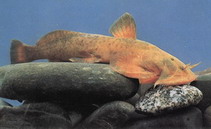
การจำแนกประเภท / ชื่อ
ชื่อสามัญ | ชื่อพ้อง | Catalog of Fishes(สกุล, ชนิด) | ITIS | CoL | WoRMS | Cloffa
>
Siluriformes (Catfishes) >
Sisoridae (Sisorid catfishes) > Glyptosterninae
Etymology: Euchiloglanis: Greek, eu = good + Greek, cheilos = lip + Greek, glanis = a fish that can eat the bait without touching the hook; a cat fish (Ref. 45335).
Eponymy: Kamakichi Kishinouye (1867–1929) was a fisheries biologist at Tokyo Imperial University, where he was a professor in the Faculty of Agriculture. [...] (Ref. 128868), visit book page.
สิ่งแวดล้อม : สิ่งแวดล้อม / เขตภูมิอากาศ / ระดับความลึก / ระยะการกระจายสินค้า
นิเวศวิทยา
; น้ำจืด สัตว์น้ำหน้าดิน. Subtropical; 32°N - 31°N, 103°E - 104°E
Asia: China. Known only from the upper Min-Jiang (Yangtze River basin, China) (Ref. 86867).
ความยาวเมื่อครบกำหนดครั้งแรก / ขนาด / น้ำหนัก / อายุ
วัยเจริญพันธุ์: Lm 15.4 range ? - ? cm
Max length : 19.3 cm NG เพศผู้/กระเทย; (Ref. 45661); common length : 15.5 cm NG เพศผู้/กระเทย; (Ref. 35840)
เงี่ยงครีบหลัง (รวม) : 1; ก้านครีบอ่อนที่หาง (รวม) : 5; เงี่ยงครีบก้น: 1; ก้านครีบอ่อนที่ก้น: 4 - 5. Euchiloglanis kishinouyei differs from E. longibarbatus by having a pointed maxillary barbel, not elongated as a thread, with the tip reaching only to the gill opening (vs. maxillary barbel elongated as a thread, with tip reaching posteriorly beyond gill opening. Euchiloglanis kishinouyei differs from E. davidi, E. longibarbatus and E. longus by lacking indentations in premaxillary tooth band (vs. with indentations). It differs from E. davidi by having the length of the pectoral fin being equal to 75.5–89.6% (vs. 90.5–117.1%) of distance between insertions of pectoral and pelvic fins and further differs from E. davidi and E. longus by having the distance between insertion of pelvic-fin and origin of anus being equal to 81.5–97.5% (vs. 100.0–125.0 and 108.9–140.6% respectively) of distance between insertions of pectoral and pelvic fins. Euchiloglanis kishinouyei differs from E. dorsoarcus and E. phongthoensis by having the anus located midway between the pelvic-fin insertion and the anal-fin origin (vs. the distance from the anus to pelvic-fin insertion equal to about 50% of the distance from the anus to the anal-fin origin) (Ref. 86867).
Body shape (shape guide): elongated.
Inhabits rocky and gravel bed pools in streams (Ref. 12045). Found in mountain rapids (Ref. 41236).
วงจรชีวิตและพฤติกรรมการผสมพันธุ์
วัยเจริญพันธุ์ | การสืบพันธุ์ | การวางไข่ | เซลสืบพันธ์ของเพศเมีย(ไข่) | ความดกของไข่ | ตัวอ่อน
Zhou, W., X. Li and A.W. Thomson, 2011. Two new species of the Glyptosternine catfish genus Euchiloglanis (Teleostei: Sisoridae) from southwest China with redescriptions of E. davidi and E. kishinouyei. Zootaxa 2871:1-18. (Ref. 86867)
สถานะบัญชีแดงของ IUCN (Ref. 130435: Version 2025-2 (Global))
ภัยคุกคามต่อมนุษย์
Harmless
การใช้ของมนุษย์
เครื่องมือ
รายงานพิเศษ
ดาวน์โหลด XML
แหล่งที่มาจากอินเตอร์เน็ต
การประมาณค่าตามแบบจำลอง
ดัชนีความหลากหลายทางวิวัฒนาการ (อ้างอิง
82804): PD
50 = 0.5625 [Uniqueness, from 0.5 = low to 2.0 = high].
Bayesian length-weight: a=0.00912 (0.00576 - 0.01445), b=3.04 (2.90 - 3.18), in cm total length, based on LWR estimates for this species & (Sub)family-body (Ref.
93245).
ระดับชั้นอาหาร (อ้างอิง
69278): 3.2 ±0.4 se; based on size and trophs of closest relatives
ความสามารถในการกลับคืนสู่ปกติ (อ้างอิง
120179): ต่ำ, เวลาต่ำสุดที่จะทำให้ประชากรเพิ่มขึ้นเป็น 2 เท่าใช้เวลา 4.5 - 14 ปี (Preliminary K or Fecundity.).
ความเสี่ยงต่อการตกปลา (Ref.
59153): Low vulnerability (14 of 100).
🛈