>
Scombriformes (Mackerels) >
Arripidae (Australian salmon)
Etymology: Arripis: Latin, arripio, arripere = to take something suddenly.
More on author: Forster.
Umwelt: Milieu / Klimazone / Tiefenbereich / Verbreitungsgebiet
Ökologie
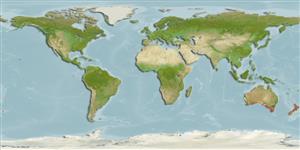
seewasser; brackwasser pelagic-neritic; anadrom (Ref. 51243); tiefenbereich 30 - 39 m (Ref. 58489). Subtropical; 27°S - 47°S, 112°E - 176°W
Southwest Pacific: southern Australia (including Tasmania, Lord Howe Island and Norfolk Island), usually Brisbane to Western Victoria, rarely to Western Australia; and New Zealand (including Chatham and Kermadec Islands).
Länge bei der ersten Reifung / Größe / Gewicht / Alter
Geschlechtsreife: Lm 32.5, range 29 - 36 cm
Max length : 89.0 cm TL Männchen/unbestimmt; (Ref. 27296); common length : 47.0 cm TL Männchen/unbestimmt; (Ref. 9258); max. veröff. Gewicht: 9.4 kg (Ref. 9988); max. veröff. Alter: 26 Jahre (Ref. 9072)
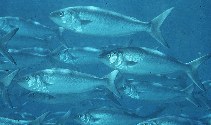
Rückenflossenstacheln (insgesamt) : 9; Rückenflossenweichstrahlen (insgesamt) : 15 - 17; Afterflossenstacheln: 3; Afterflossenweichstrahlen: 9 - 10; Wirbelzahl: 25. Adults are dark blue-green above and silvery below, with irregularly defined spots arranged laterally in indistinct rows (Ref. 33616). Length of upper lobe of caudal fin < 29.9% SL, more or less equal to, or less than, the length fo the head (Ref. 9701).
Body shape (shape guide): fusiform / normal; Cross section: compressed.
Inhabit continental shelf waters including estuaries, bays and inlets (Ref. 6390). Found between depths of 30 m (Ref. 33616) and 39 m (Ref. 58489). They enter rivers (Ref. 9002). Juveniles form school in shallow coastal bays and estuaries; adults move in large schools along shores (Ref. 9002), and can move over reefs in depths just sufficient to cover their bodies (Ref. 6390). They form large surface aggregations in deep water (Ref. 6390). Feed mainly on fishes but also on pelagic crustaceans, especially krill (Nyctiphanes australis). Take also food from the seabed. Fish smaller than 10 cm feed predominantly on copepods (Ref. 9072). Utilized fresh, canned and frozen; can be steamed, fried, broiled, boiled, microwaved and baked (Ref. 9988).
Eastern Australian salmon are probably serial batch spawners (Ref. 27961).
Paulin, C., 1993. Review of the Australian fish Family Arripididae (Percomorpha), with the description of a new species. Aust. J. Mar. Freshwat. Res. 44(3):459-471. (Ref. 9701)
IUCN Rote Liste Status (Ref. 130435: Version 2025-2 (Global))
Bedrohung für Menschen
Harmless
Nutzung durch Menschen
Fischereien: kommerziell; Sportfisch: ja; Köder: usually
Tools
Zusatzinformationen
Download XML
Internet Quellen
Schätzungen auf der Grundlage von Modellen
Bevorzugte Temperatur (Ref.
123201): 15.6 - 22.3, mean 17.4 °C (based on 14 cells).
Phylogenetischer Diversitätsindex (Ref.
82804): PD
50 = 0.6250 [Uniqueness, from 0.5 = low to 2.0 = high].
Bayesian length-weight: a=0.00955 (0.00346 - 0.02636), b=3.01 (2.78 - 3.24), in cm total length, based on LWR estimates for this (Sub)family-body shape (Ref.
93245).
Trophische Ebene (Ref.
69278): 4.1 ±0.6 se; based on diet studies.
Generation time: 4.1 (3.3 - 7.9) years. Estimated as median ln(3)/K based on 11
growth studies.
Widerstandsfähigkeit (Ref.
120179): mittel, Verdopplung der Population dauert 1,4 - 4,4 Jahre. (K=0.2-0.3; tm=4).
Prior r = 0.39, 95% CL = 0.26 - 0.59, Based on 2 full stock assessments.
Anfälligkeit der Fischerei (Ref.
59153): Moderate vulnerability (37 of 100).
🛈
Klimaanfälligkeit (Ref.
125649): Very high vulnerability (100 of 100).
🛈
Nährstoffe (Ref.
124155): Calcium = 52.1 [34.3, 88.4] mg/100g; Iron = 1.2 [0.8, 1.8] mg/100g; Protein = 20.7 [18.4, 22.6] %; Omega3 = 0.365 [0.227, 0.591] g/100g; Selenium = 19.2 [11.0, 32.9] μg/100g; VitaminA = 13.8 [5.4, 36.4] μg/100g; Zinc = 0.672 [0.506, 0.912] mg/100g (wet weight); based on
nutrient studies.