>
Scombriformes (Mackerels) >
Arripidae (Australian salmon)
Etymology: Arripis: Latin, arripio, arripere = to take something suddenly.
More on author: Forster.
Lingkungan: lingkungan / zona iklim / kisaran kedalaman / jangkauan distribusi
Ekologi
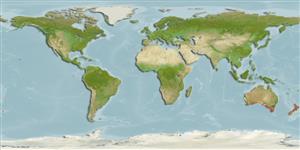
laut; payau pelagic-neritic; anadromus (ruaya dari laut ke air tawar) (Ref. 51243); kisaran kedalaman 30 - 39 m (Ref. 58489). Subtropical; 27°S - 47°S, 112°E - 176°W
Southwest Pacific: southern Australia (including Tasmania, Lord Howe Island and Norfolk Island), usually Brisbane to Western Victoria, rarely to Western Australia; and New Zealand (including Chatham and Kermadec Islands).
Panjang pada saat jatuh tempo pertama / Ukuran / Berat / umur
Kematangan: Lm 32.5, range 29 - 36 cm
Max length : 89.0 cm TL jantan/; (Ref. 27296); common length : 47.0 cm TL jantan/; (Ref. 9258); Berat maksimum terpublikasi: 9.4 kg (Ref. 9988); Umur maksimum dilaporkan: 26 Tahun (Ref. 9072)
deskripsi pendek
Kunci identifiaksi (pengenalan) | Morfologi | Morfometrik
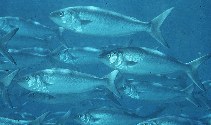
Duri punggung (Keseluruhan (total)) : 9; duri punggung lunak (Keseluruhan (total)) : 15 - 17; Duri dubur: 3; Sirip dubur lunak: 9 - 10; vertebrata, bertulang belakang: 25. Adults are dark blue-green above and silvery below, with irregularly defined spots arranged laterally in indistinct rows (Ref. 33616). Length of upper lobe of caudal fin < 29.9% SL, more or less equal to, or less than, the length fo the head (Ref. 9701).
Body shape (shape guide): fusiform / normal; Cross section: compressed.
Inhabit continental shelf waters including estuaries, bays and inlets (Ref. 6390). Found between depths of 30 m (Ref. 33616) and 39 m (Ref. 58489). They enter rivers (Ref. 9002). Juveniles form school in shallow coastal bays and estuaries; adults move in large schools along shores (Ref. 9002), and can move over reefs in depths just sufficient to cover their bodies (Ref. 6390). They form large surface aggregations in deep water (Ref. 6390). Feed mainly on fishes but also on pelagic crustaceans, especially krill (Nyctiphanes australis). Take also food from the seabed. Fish smaller than 10 cm feed predominantly on copepods (Ref. 9072). Utilized fresh, canned and frozen; can be steamed, fried, broiled, boiled, microwaved and baked (Ref. 9988).
Eastern Australian salmon are probably serial batch spawners (Ref. 27961).
Paulin, C., 1993. Review of the Australian fish Family Arripididae (Percomorpha), with the description of a new species. Aust. J. Mar. Freshwat. Res. 44(3):459-471. (Ref. 9701)
Status IUCN Red List (Ref. 130435: Version 2025-2 (Global))
ancaman kepada manusia
Harmless
penggunaan manusia
Perikanan: komersial; Ikan buruan: ya; umpan: usually
Alat, peralatan
laporan khas
muat turun XML
Sumber internet
Estimasi berdasarkan model
Suhu yang disukai (Acuan
123201): 15.6 - 22.3, mean 17.4 °C (based on 14 cells).
Indeks keanekaragaman filogenetik (Acuan
82804): PD
50 = 0.6250 [Uniqueness, from 0.5 = low to 2.0 = high].
Bayesian length-weight: a=0.00955 (0.00346 - 0.02636), b=3.01 (2.78 - 3.24), in cm total length, based on LWR estimates for this (Sub)family-body shape (Ref.
93245).
Tingkat Trofik (Acuan
69278): 4.1 ±0.6 se; based on diet studies.
Generation time: 4.1 (3.3 - 7.9) years. Estimated as median ln(3)/K based on 11
growth studies.
Daya lenting (Acuan
120179): sedang, Waktu penggandaan populasi minimum 1.4 - 4.4 tahun (K=0.2-0.3; tm=4).
Prior r = 0.39, 95% CL = 0.26 - 0.59, Based on 2 full stock assessments.
Kerentanan Penangkapan Ikan (Ref.
59153): Moderate vulnerability (37 of 100).
🛈
Kerentanan Iklim (Ref.
125649): Very high vulnerability (100 of 100).
🛈
Nutrisi (Ref.
124155): Calcium = 52.1 [34.3, 88.4] mg/100g; Iron = 1.2 [0.8, 1.8] mg/100g; Protein = 20.7 [18.4, 22.6] %; Omega3 = 0.365 [0.227, 0.591] g/100g; Selenium = 19.2 [11.0, 32.9] μg/100g; VitaminA = 13.8 [5.4, 36.4] μg/100g; Zinc = 0.672 [0.506, 0.912] mg/100g (wet weight); based on
nutrient studies.