>
Acanthuriformes (Surgeonfishes) >
Chaetodontidae (Butterflyfishes)
Etymology: Chaetodon: Greek, chaite = hair + Greek, odous = teeth (Ref. 45335).
Eponymy: W Höfler was a friend of Steindachner who he describes as his ‘dear friend’ and his best provider of fish specimens from Africa. He collected the types. We have failed to find further details. (Ref. 128868), visit book page.
More on author: Steindachner.
Environnement : milieu / zone climatique / profondeur / gamme de distribution
Écologie
marin récifal; profondeur 10 - 150 m (Ref. 6943), usually 20 - 75 m (Ref. 6943). Subtropical
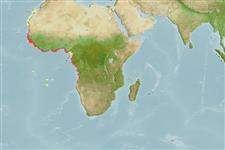
Eastern Atlantic: Cape Blanc and Levrier Bay, Mauritania south to Angola. Two records in the Mediterranean.
Taille / Poids / Âge
Maturité: Lm ? range ? - ? cm
Max length : 27.0 cm TL mâle / non sexé; (Ref. 5476); common length : 17.0 cm TL mâle / non sexé; (Ref. 5476)
Description synthétique
Clés d'identification | Morphologie | Morphométrie
Épines dorsales (Total) : 11; Rayons mous dorsaux (Total) : 1 - 24; Épines anales: 3; Rayons mous anaux: 16 - 17.
Body shape (shape guide): short and / or deep; Cross section: compressed.
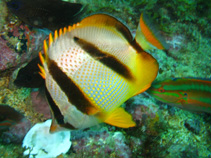
Coastal species (Ref. 27000). Prefer hard or rocky substrate, also trawled on sandy or muddy bottoms (Ref. 6943). Solitary or comes in pairs when adults, possibly gregarious when young. Feed on bottom invertebrates (Ref. 6759). Oviparous (Ref. 205). Form pairs during breeding (Ref. 205).
Cycle de vie et comportement reproducteur
Maturité | Reproduction | Frai | Œufs | Fécondité | Larves
Form pairs during breeding (Ref. 205).
Maugé, L.A., 1990. Chaetodontidae. p. 837-840. In J.C. Quero, J.C. Hureau, C. Karrer, A. Post and L. Saldanha (eds.) Check-list of the fishes of the eastern tropical Atlantic (CLOFETA). JNICT, Lisbon; SEI, Paris; and UNESCO, Paris. Vol. 2. (Ref. 6943)
Statut dans la liste rouge de l'IUCN (Ref. 130435: Version 2025-2 (Global))
Menace pour l'homme
Reports of ciguatera poisoning (Ref. 30303)
Utilisations par l'homme
Pêcheries: sans intérêt; Aquarium: Commercial
Outils
Articles particuliers
Télécharger en XML
Sources Internet
Estimations basées sur des modèles
Température préférée (Réf.
123201): 18.2 - 27.9, mean 25.3 °C (based on 112 cells).
Indice de diversité phylogénétique (Réf.
82804): PD
50 = 0.5000 [Uniqueness, from 0.5 = low to 2.0 = high].
Bayesian length-weight: a=0.02291 (0.01123 - 0.04674), b=3.00 (2.83 - 3.17), in cm total length, based on LWR estimates for this Genus-body shape (Ref.
93245).
Niveau trophique (Réf.
69278): 3.5 ±0.37 se; based on food items.
Résilience (Réf.
120179): Haut, temps minimum de doublement de population inférieur à 15 mois (Preliminary K or Fecundity.).
Vulnérabilité de la pêche (Ref.
59153): Low vulnerability (17 of 100).
🛈
Nutriments (Ref.
124155): Calcium = 40.3 [17.9, 87.4] mg/100g; Iron = 0.66 [0.36, 1.16] mg/100g; Protein = 19.4 [18.3, 20.6] %; Omega3 = 0.201 [0.112, 0.357] g/100g; Selenium = 20.2 [9.4, 40.4] μg/100g; VitaminA = 29 [7, 117] μg/100g; Zinc = 0.719 [0.455, 1.103] mg/100g (wet weight);