>
Polypteriformes (Bichirs) >
Polypteridae (Bichirs)
Etymology: Polypterus: Greek, poly = a lot of + Greek, pteron = wing, fin (Ref. 45335); bichir: Named after the local name for the fish (Ref. 43537).
More on author: Lacepède.
Entorno: milieu / zona climática / rango de profundidad / gama de distribución
Ecología
; agua dulce demersal; potamodromo (Ref. 51243). Tropical
Africa: The subspecies Polypterus bichir bichir is known from the Chad basin, Nile River basin and Lake Turkana (Ref. 2835, 81263). Reports from Lake Turkana and the Ouémé are questionable as unsupported by photographs or museum specimens (Ref. 122071). The subspecies Polypterus bichir lapradei is known from the rivers Senegal, Gambia, Geba, Volta and Niger (Ref. 2835, 81263).
Tamaño / Peso / Edad
Madurez: Lm ? range ? - ? cm
Max length : 74.0 cm TL macho / no sexado; (Ref. 81263); peso máximo publicado: 2.7 kg (Ref. 367)
Espinas dorsales (total) : 13 - 18; Radios blandos dorsales (total) : 0; Espinas anales: 0; Radios blandos anales: 13 - 16; Vértebra: 61 - 62. Diagnosis: Polypterus bichir is characterized by a lower jaw slightly longer than upper jaw and a pectoral fin reaching the first dorsal ray (Ref. 2835, 42908, 81263). The subspecies P. bichir bichir has 63 to 70 scales in lateral line, 14 to 18 dorsal fin rays and 11 to 13 pelvic fin rays (Ref. 367, 81263). The subspecies P. bichir lapradei has 58 to 68 scales in lateral line, 13 to 15 dorsal fin rays and 13 to 16 pelvic fin rays (Ref. 367, 81263).
Body shape (shape guide): elongated; Cross section: circular.
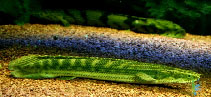
Facultative air-breathing (Ref. 126274); Polypterus bichir bichir likes shallow water and will often lie basking fo hours near the surface, but when swimming the fish is very pliant, and can turn and twist like an eel (Ref. 4904). The eggs are deposited in weeds, where the adult fish guards the eggs and young (Ref. 36900). It feeds on bottom-feeding fish (Ref. 36900) and is essentially piscivorous (Ref. 367).
Ciclo vital y comportamiento de apareamiento
Madurez | Reproducción | Puesta | Huevos | Fecundidad | Larva
Gosse, J.P. and J. Daget, 2003. Polypteridae. p. 101-112. In D. Paugy, C. Lévêque and G.G Teugels (eds.) The fresh and brackish water fishes of West Africa Volume 1. Coll. faune et flore tropicales 40. Institut de recherche de développement, Paris, France, Muséum national d'histoire naturelle, Paris, France and Musée royal de l'Afrique Central, Tervuren, Belgium, 457p. (Ref. 81263)
Situación en la Lista Roja de la UICN (Ref. 130435: Version 2025-2 (Global))
Amenaza para el ser humano
Harmless
Usos humanos
Pesquerías: comercial
Herramientas
Informes especiales
Descargar XML
Fuentes de Internet
Estimaciones basadas en modelos
Índice de diversidad filogenética (Referencia
82804): PD
50 = 0.5003 [Uniqueness, from 0.5 = low to 2.0 = high].
Bayesian length-weight: a=0.00457 (0.00194 - 0.01077), b=3.05 (2.85 - 3.25), in cm total length, based on LWR estimates for this (Sub)family-body shape (Ref.
93245).
Nivel trófico (Referencia
69278): 4.5 ±0.80 se; based on food items.
Resiliencia (Referencia
120179): Alto, población duplicada en un tiempo mínimo inferior a 15 meses (Preliminary K or Fecundity.).
Vulnerabilidad pesquera (Ref.
59153): Moderate to high vulnerability (50 of 100).
🛈