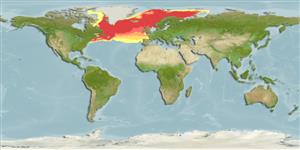
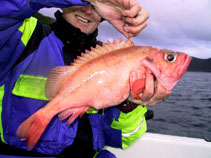
Miljö: miljö / Klimatzon / djupintervall / distributionsområde
Ekologi
marina pelagic-oceanic; havsvandrande (Ref. 51243); djupintervall 100 - 1000 m, usually 100 - 500 m (Ref. 35388). Temperate; 3°C - 7°C (Ref. 35388); 79°N - 39°N, 75°W - 71°E
Eastern Atlantic: Kattegat and North Sea, northward to Spitsbergen, southern part of Barents Sea eastward to Kanin Banks and Novaya Zemlya, rare in White Sea, Iceland and eastern Greenland. Western Atlantic: Greenland and southeastern Labrador in Canada to New Jersey in USA (Ref. 7251).
Längd vid första mognad / Storlek / Vikt / Ålder
Könsmognad: Lm 38.9, range 38 - 41 cm
Max length : 100.0 cm TL hane/ej könsbestämd; (Ref. 4570); common length : 45.0 cm TL hane/ej könsbestämd; (Ref. 4570); publicerad maxvikt: 15.0 kg (Ref. 35388); rapporterad maxålder: 60 år (Ref. 35388)
Found off the coast from 100-1000 m; juveniles found in fjords, bays and inshore waters. Normally trawled in deep water (Ref. 9988). Benthic (Ref. 5951). Feed mostly on euphausiids in summer; herrings in autumn and winter; capelins, herrings, euphausiids and ctenophores in spring. Gregarious throughout life. A slow growing species (Ref. 9988). Ovoviviparous, gonads of male and female do not mature at the same time. The spermatozoa are kept in the ovary of the female after copulation until such time that the eggs ripen paving the way for fertilization (Ref. 74488). Copulation takes place in late summer or early autumn (Ref. 35388, 34817); in winter females give birth to 50,000-350,000 pelagic larvae of 8 mm length (Ref. 35388). Utilized fresh and frozen; eaten fried, broiled, microwaved and baked (Ref. 9988).
Gonads of male and female do not mature at the same time. The spermatozoa are kept in the ovary of the female after copulation until such time that the eggs ripen paving the way for fertilisation (Ref. 74488). Gives birth to 50,000-350,000 pelagic larvae of 8 mm length (Ref. 35388).
Fernholm, B. and A. Wheeler, 1983. Linnaean fish specimens in the Swedish Museum of Natural History, Stockholm. Zool. J. Linn. Soc., 78(3):199-286. (Ref. 83993)
Status på IUCN:s rödlista (Ref. 130435: Version 2025-2 (Global))
Hot mot människor
Reports of ciguatera poisoning (Ref. 30911)
Mänskliga användningsområden
Fiskeri: kommersiellt viktig; sportfisk: ja
Verktyg
Särskilda rapporter
Ladda ner XML
Internet-källor
Uppskattningar baserade på modeller
Önskad temperatur (Ref.
123201): 0.6 - 9.3, mean 3.7 °C (based on 1514 cells).
Index för fylogenetisk mångfald (Ref.
82804): PD
50 = 0.5000 [Uniqueness, from 0.5 = low to 2.0 = high].
Bayesian length-weight: a=0.01413 (0.00662 - 0.03015), b=3.04 (2.86 - 3.22), in cm total length, based on LWR estimates for this Genus-body shape (Ref.
93245).
Trofisk nivå (Ref.
69278): 4.0 ±0.68 se; based on food items.
Resiliens (Ref.
120179): Låg, lägsta populationsfördubblingstid 4,5-14 år (rm=0.23; K=0.06-0.08; tm=10-12; tmax=60; Fec= 19,000-350,000).
Prior r = 0.30, 95% CL = 0.20 - 0.45, Based on 5 full stock assessments.
Sårbarhet i fisket (Ref.
59153): High to very high vulnerability (71 of 100).
🛈
Sårbarhet för klimatet (Ref.
125649): High to very high vulnerability (69 of 100).
🛈
Näringsämnen (Ref.
124155): Calcium = 12.3 [5.5, 33.4] mg/100g; Iron = 0.23 [0.10, 0.51] mg/100g; Protein = 18.3 [17.1, 19.5] %; Omega3 = 1.29 [0.51, 3.25] g/100g; Selenium = 44.8 [19.0, 116.1] μg/100g; VitaminA = 20.7 [6.3, 68.0] μg/100g; Zinc = 0.342 [0.187, 0.613] mg/100g (wet weight); based on
nutrient studies.