Environnement : milieu / zone climatique / profondeur / gamme de distribution
Écologie
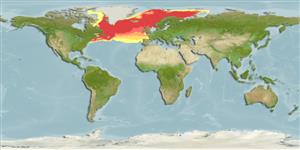
marin pelagic-oceanic; océanodrome (Ref. 51243); profondeur 100 - 1000 m, usually 100 - 500 m (Ref. 35388). Temperate; 3°C - 7°C (Ref. 35388); 79°N - 39°N, 75°W - 71°E
Eastern Atlantic: Kattegat and North Sea, northward to Spitsbergen, southern part of Barents Sea eastward to Kanin Banks and Novaya Zemlya, rare in White Sea, Iceland and eastern Greenland. Western Atlantic: Greenland and southeastern Labrador in Canada to New Jersey in USA (Ref. 7251).
Longueur à la première maturité / Taille / Poids / Âge
Maturité: Lm 38.9, range 38 - 41 cm
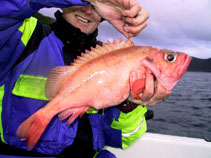
Max length : 100.0 cm TL mâle / non sexé; (Ref. 4570); common length : 45.0 cm TL mâle / non sexé; (Ref. 4570); poids max. publié: 15.0 kg (Ref. 35388); âge max. reporté: 60 années (Ref. 35388)
Found off the coast from 100-1000 m; juveniles found in fjords, bays and inshore waters. Normally trawled in deep water (Ref. 9988). Benthic (Ref. 5951). Feed mostly on euphausiids in summer; herrings in autumn and winter; capelins, herrings, euphausiids and ctenophores in spring. Gregarious throughout life. A slow growing species (Ref. 9988). Ovoviviparous, gonads of male and female do not mature at the same time. The spermatozoa are kept in the ovary of the female after copulation until such time that the eggs ripen paving the way for fertilization (Ref. 74488). Copulation takes place in late summer or early autumn (Ref. 35388, 34817); in winter females give birth to 50,000-350,000 pelagic larvae of 8 mm length (Ref. 35388). Utilized fresh and frozen; eaten fried, broiled, microwaved and baked (Ref. 9988).
Gonads of male and female do not mature at the same time. The spermatozoa are kept in the ovary of the female after copulation until such time that the eggs ripen paving the way for fertilisation (Ref. 74488). Gives birth to 50,000-350,000 pelagic larvae of 8 mm length (Ref. 35388).
Fernholm, B. and A. Wheeler, 1983. Linnaean fish specimens in the Swedish Museum of Natural History, Stockholm. Zool. J. Linn. Soc., 78(3):199-286. (Ref. 83993)
Statut dans la liste rouge de l'IUCN (Ref. 130435: Version 2025-2 (Global))
Menace pour l'homme
Reports of ciguatera poisoning (Ref. 30911)
Utilisations par l'homme
Pêcheries: hautement commercial; pêche sportive: oui
Outils
Articles particuliers
Télécharger en XML
Sources Internet
Estimations basées sur des modèles
Température préférée (Réf.
123201): 0.6 - 9.3, mean 3.7 °C (based on 1514 cells).
Indice de diversité phylogénétique (Réf.
82804): PD
50 = 0.5000 [Uniqueness, from 0.5 = low to 2.0 = high].
Bayesian length-weight: a=0.01413 (0.00662 - 0.03015), b=3.04 (2.86 - 3.22), in cm total length, based on LWR estimates for this Genus-body shape (Ref.
93245).
Niveau trophique (Réf.
69278): 4.0 ±0.68 se; based on food items.
Résilience (Réf.
120179): Faible, temps minimum de doublement de population : 4,5 à 14 années (rm=0.23; K=0.06-0.08; tm=10-12; tmax=60; Fec= 19,000-350,000).
Prior r = 0.30, 95% CL = 0.20 - 0.45, Based on 5 full stock assessments.
Vulnérabilité de la pêche (Ref.
59153): High to very high vulnerability (71 of 100).
🛈
Vulnérabilité climatique (Ref.
125649): High to very high vulnerability (69 of 100).
🛈
Nutriments (Ref.
124155): Calcium = 12.3 [5.5, 33.4] mg/100g; Iron = 0.23 [0.10, 0.51] mg/100g; Protein = 18.3 [17.1, 19.5] %; Omega3 = 1.29 [0.51, 3.25] g/100g; Selenium = 44.8 [19.0, 116.1] μg/100g; VitaminA = 20.7 [6.3, 68.0] μg/100g; Zinc = 0.342 [0.187, 0.613] mg/100g (wet weight); based on
nutrient studies.