>
Gadiformes (Cods) >
Macrouridae (Grenadiers or rattails)
Etymology: Malacocephalus: Greek, malakos = soft + Greek, kephale = head (Ref. 45335).
More on author: Lowe.
Miljö: miljö / Klimatzon / djupintervall / distributionsområde
Ekologi
marina djupbottenlevande; ej vandrande; djupintervall 200 - 1000 m (Ref. 1371), usually 300 - 750 m (Ref. 3587). Deep-water; 62°N - 43°S, 97°W - 124°E (Ref. 1371)
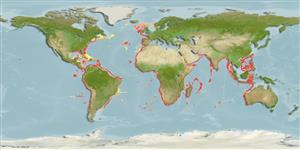
Atlantic, Indian and Pacific: Western Atlantic: Strait of Florida to Brazil, Gulf of Mexico and Caribbean Sea. Eastern Atlantic: Iceland (Ref. 12462) and Faroes to South Africa. Indian Ocean: Arabian Sea, Bay of Bengal, off Maldives and off East African coast. Western Pacific: Indonesian area and Australia. Eastern Central Pacific (Ref. 9315). Malacocephalus hawaiiensis, Malacocephalus luzonensis, and Malacocephalus nipponensis are closely related to Malacocephalus laevis and may eventually prove to represent populations of this species, if a comprehensive comparison of material from the Atlantic, Indian and Pacific oceans is done (Ref. 1371).
Storlek / Vikt / Ålder
Könsmognad: Lm ? range ? - ? cm
Max length : 60.0 cm TL hane/ej könsbestämd; (Ref. 2800); common length : 40.0 cm TL hane/ej könsbestämd; (Ref. 26999)
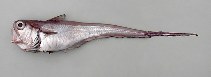
Taggstrålar i ryggfenan (totalt) : 2; Mjukstrålar i ryggfenan (totalt) : 229; Taggstrålar i analfenan: 0. Head uniformly scaled, including the mandibles and the ventral aspects of the snout and suborbital. Snout blunt, its tip with a conical tubercle. The trunk is short, the body tapers abruptly from behind the first dorsal fin. The caudal fin is absent.
Body shape (shape guide): elongated; Cross section: circular.
Found on continental slopes (Ref. 1371). Utilized mainly for fishmeal and oil (Ref. 1371). In the past, fishers in the North Atlantic were reported to have used the luminescent excretion from the ventral light organ to enhance baits used for cod fishing (Ref. 1371).
Livscykel och parningsbeteende
Könsmognad | Reproduktion | Lek | Ägg | Fekunditet | Larver
Cohen, D.M., T. Inada, T. Iwamoto and N. Scialabba, 1990. FAO species catalogue. Vol. 10. Gadiform fishes of the world (Order Gadiformes). An annotated and illustrated catalogue of cods, hakes, grenadiers and other gadiform fishes known to date. FAO Fish. Synop. 125(10). Rome: FAO. 442 p. (Ref. 1371)
Status på IUCN:s rödlista (Ref. 130435: Version 2025-2 (Global))
Hot mot människor
Harmless
Mänskliga användningsområden
Fiskeri: mindre kommeriell
Verktyg
Särskilda rapporter
Ladda ner XML
Internet-källor
Uppskattningar baserade på modeller
Önskad temperatur (Ref.
123201): 6.1 - 13.9, mean 9.5 °C (based on 824 cells).
Index för fylogenetisk mångfald (Ref.
82804): PD
50 = 0.5078 [Uniqueness, from 0.5 = low to 2.0 = high].
Bayesian length-weight: a=0.00129 (0.00075 - 0.00221), b=3.14 (2.99 - 3.29), in cm total length, based on LWR estimates for this species & (Sub)family-body (Ref.
93245).
Trofisk nivå (Ref.
69278): 3.8 ±0.56 se; based on food items.
Resiliens (Ref.
120179): Mycket låg, lägsta populationsfördubblingstid mer än 14 år (Preliminary K or Fecundity.).
Sårbarhet i fisket (Ref.
59153): Moderate vulnerability (44 of 100).
🛈
Näringsämnen (Ref.
124155): Calcium = 19.5 [11.4, 49.2] mg/100g; Iron = 0.413 [0.190, 0.856] mg/100g; Protein = 16.4 [14.7, 18.1] %; Omega3 = 0.211 [0.102, 0.439] g/100g; Selenium = 21.6 [8.4, 53.6] μg/100g; VitaminA = 17.4 [3.5, 83.1] μg/100g; Zinc = 0.395 [0.249, 0.636] mg/100g (wet weight);