>
Gadiformes (Cods) >
Macrouridae (Grenadiers or rattails)
Etymology: Malacocephalus: Greek, malakos = soft + Greek, kephale = head (Ref. 45335).
More on author: Lowe.
Umwelt: Milieu / Klimazone / Tiefenbereich / Verbreitungsgebiet
Ökologie
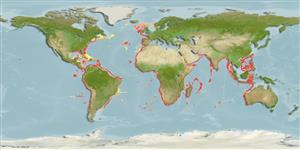
seewasser bathydemersal; standorttreu; tiefenbereich 200 - 1000 m (Ref. 1371), usually 300 - 750 m (Ref. 3587). Deep-water; 62°N - 43°S, 97°W - 124°E (Ref. 1371)
Atlantic, Indian and Pacific: Western Atlantic: Strait of Florida to Brazil, Gulf of Mexico and Caribbean Sea. Eastern Atlantic: Iceland (Ref. 12462) and Faroes to South Africa. Indian Ocean: Arabian Sea, Bay of Bengal, off Maldives and off East African coast. Western Pacific: Indonesian area and Australia. Eastern Central Pacific (Ref. 9315). Malacocephalus hawaiiensis, Malacocephalus luzonensis, and Malacocephalus nipponensis are closely related to Malacocephalus laevis and may eventually prove to represent populations of this species, if a comprehensive comparison of material from the Atlantic, Indian and Pacific oceans is done (Ref. 1371).
Größe / Gewicht / Alter
Geschlechtsreife: Lm ? range ? - ? cm
Max length : 60.0 cm TL Männchen/unbestimmt; (Ref. 2800); common length : 40.0 cm TL Männchen/unbestimmt; (Ref. 26999)
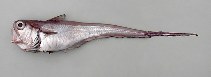
Rückenflossenstacheln (insgesamt) : 2; Rückenflossenweichstrahlen (insgesamt) : 229; Afterflossenstacheln: 0. Head uniformly scaled, including the mandibles and the ventral aspects of the snout and suborbital. Snout blunt, its tip with a conical tubercle. The trunk is short, the body tapers abruptly from behind the first dorsal fin. The caudal fin is absent.
Body shape (shape guide): elongated; Cross section: circular.
Found on continental slopes (Ref. 1371). Utilized mainly for fishmeal and oil (Ref. 1371). In the past, fishers in the North Atlantic were reported to have used the luminescent excretion from the ventral light organ to enhance baits used for cod fishing (Ref. 1371).
Lebenszyklus und Paarungsverhalten
Geschlechtsreife | Fortpflanzung | Ablaichen | Eier | Fruchtbarkeit | Larven
Cohen, D.M., T. Inada, T. Iwamoto and N. Scialabba, 1990. FAO species catalogue. Vol. 10. Gadiform fishes of the world (Order Gadiformes). An annotated and illustrated catalogue of cods, hakes, grenadiers and other gadiform fishes known to date. FAO Fish. Synop. 125(10). Rome: FAO. 442 p. (Ref. 1371)
IUCN Rote Liste Status (Ref. 130435: Version 2025-2 (Global))
Bedrohung für Menschen
Harmless
Nutzung durch Menschen
Fischereien: weniger kommerziell
Tools
Zusatzinformationen
Download XML
Internet Quellen
Schätzungen auf der Grundlage von Modellen
Bevorzugte Temperatur (Ref.
123201): 6.1 - 13.9, mean 9.5 °C (based on 824 cells).
Phylogenetischer Diversitätsindex (Ref.
82804): PD
50 = 0.5078 [Uniqueness, from 0.5 = low to 2.0 = high].
Bayesian length-weight: a=0.00129 (0.00075 - 0.00221), b=3.14 (2.99 - 3.29), in cm total length, based on LWR estimates for this species & (Sub)family-body (Ref.
93245).
Trophische Ebene (Ref.
69278): 3.8 ±0.56 se; based on food items.
Widerstandsfähigkeit (Ref.
120179): sehr niedrig, Verdopplung der Population dauert mehr als 14 Jahre. (Preliminary K or Fecundity.).
Anfälligkeit der Fischerei (Ref.
59153): Moderate vulnerability (44 of 100).
🛈
Nährstoffe (Ref.
124155): Calcium = 19.5 [11.4, 49.2] mg/100g; Iron = 0.413 [0.190, 0.856] mg/100g; Protein = 16.4 [14.7, 18.1] %; Omega3 = 0.211 [0.102, 0.439] g/100g; Selenium = 21.6 [8.4, 53.6] μg/100g; VitaminA = 17.4 [3.5, 83.1] μg/100g; Zinc = 0.395 [0.249, 0.636] mg/100g (wet weight);