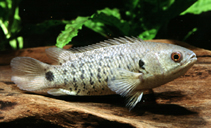
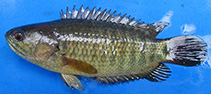
Môi trường: môi trường / vùng khí hậu / Mức độ sâu / phạm vi phân phối
Sinh thái học
; nước ngọt; thuộc về nước lợ gần đáy; di cư trong nước ngọt (Ref. 126106); mức độ sâu 0 - ? m (Ref. 4833). Tropical; 22°C - 30°C (Ref. 1672); 28°N - 10°S
Asia: India to Wallace line including China. May have been distributed in more areas than were commonly reported.
Bộ gần gũi / Khối lượng (Trọng lượng) / Tuổi
Chín muồi sinh dục: Lm ? range ? - ? cm
Max length : 25.0 cm TL con đực/không giới tính; (Ref. 4833); common length : 12.5 cm TL con đực/không giới tính; (Ref. 2686)
Các tia vây lưng cứng (tổng cộng) : 16 - 20; Các vây lưng mềm (tổng cộng) : 7 - 10; Tia cứng vây hậu môn: 9 - 11; Tia mềm vây hậu môn: 8 - 11. Color in life dark to pale greenish, very pale below, back dusky to olive; head with longitudinal stripes ventrally; posterior margin of opercle with a dark spot; iris golden reddish. Body form variable, affected by age and amount of food consumed. Scaled head with 4-5 rows between eye and rear margin of preoperculum. Scales large and regularly arranged, ciliate.
Body shape (shape guide): fusiform / normal; Cross section: compressed.
Obligate air-breathing (Ref. 126274); Found mostly in canals, lakes, ponds, swamps and estuaries (Ref. 41236, 57235). Adults occur in medium to large rivers, brooks, flooded fields and stagnant water bodies including sluggish flowing canals (Ref. 12975). Often found in areas with dense vegetation (Ref. 12693). Can tolerate extremely unfavorable water conditions and is associated mainly with turbid, stagnant waters (Ref. 6028). They remain buried under the mud during dry season (Ref. 1479). They feed on macrophytic vegetation, shrimps and fish fry (Ref. 6028). Reported to undertake lateral migration from the Mekong mainstream, or other permanent water bodies, to flooded areas during the flood season and return to the permanent water bodies at the onset of the dry season (Ref. 37770). During the dry season, they stay in pools associated with submerged woods and shrubs (Ref. 37770). Posses an accessory air-breathing organ (Ref. 2847). They are able to survive for several days or weeks out of water if the air breathing organs can be kept moist (Ref. 1479). Quite famous for its ability to walk; important food fish in SE Asia, considered as a tasty food fish (Ref. 6565) but not of the finest quality since it is bony (Ref. 2686). Usually sold live in markets where it is kept alive for several days by keeping it moist (Ref. 12693). Economic foodfish in the Southeast Asia (Ref. 57235).
Guards eggs at the surface of hypoxic waters (Ref. 7471).
Talwar, P.K. and A.G. Jhingran, 1991. Inland fishes of India and adjacent countries. Volume 2. A.A. Balkema, Rotterdam, i-xxii + 543-1158, 1 pl. (Ref. 4833)
Tình trạng Sách đỏ IUCN (Ref. 130435: Version 2025-2 (Global))
Mối đe dọa đối với con người
Harmless
Sử dụng của con người
Các nghề cá: tính thương mại; Nuôi trồng thủy sản: tính thương mại; Bể nuôi cá: Tính thương mại
Các công cụ
Báo cáo đặc biệt
Tải xuống XML
Các nguồn internet
Ước tính dựa trên mô hình
Chỉ số đa dạng phát sinh loài (Tài liệu tham khảo
82804): PD
50 = 0.7500 [Uniqueness, from 0.5 = low to 2.0 = high].
Bayesian length-weight: a=0.02344 (0.01756 - 0.03129), b=2.93 (2.85 - 3.01), in cm total length, based on LWR estimates for this species (Ref.
93245).
Mức dinh dưỡng (Tài liệu tham khảo
69278): 3.0 ±0.4 se; based on diet studies.
Generation time: 0.8 ( na - na) years. Estimated as median ln(3)/K based on 1
growth studies.
Thích nghi nhanh (Tài liệu tham khảo
120179): Chiêù cao, thời gian nhân đôi của chủng quần tối thiểu là dưới 15 tháng (Assuming tm=1; K=1.4; Fec=40,000-80,000).
Sự dễ bị tổn thương của nghề đánh cá (Ref.
59153): Low vulnerability (15 of 100).
🛈
Chất dinh dưỡng (Ref.
124155): Calcium = 76.8 [41.1, 193.0] mg/100g; Iron = 1.19 [0.69, 2.09] mg/100g; Protein = 17.8 [16.8, 18.9] %; Omega3 = 0.252 [0.115, 0.556] g/100g; Selenium = 85.1 [35.7, 194.4] μg/100g; VitaminA = 43.8 [20.5, 94.6] μg/100g; Zinc = 0.958 [0.599, 1.533] mg/100g (wet weight); based on
nutrient studies.