Ambiente: milieu / zona climatica / distribuzione batimetrica / gamma di distribuzione
Ecologia
; acqua dolce; salmastro demersale; potamodromo (Ref. 126106); distribuzione batimetrica 0 - ? m (Ref. 4833). Tropical; 22°C - 30°C (Ref. 1672); 28°N - 10°S
Asia: India to Wallace line including China. May have been distributed in more areas than were commonly reported.
Dimensione / Peso / Età
Maturità: Lm ? range ? - ? cm
Max length : 25.0 cm TL maschio/sesso non determinato; (Ref. 4833); common length : 12.5 cm TL maschio/sesso non determinato; (Ref. 2686)
Breve descrizione
Chiavi di identificazione | Morfologia | Morfometria
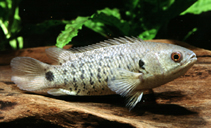
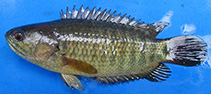
Spine dorsali (totale) : 16 - 20; Raggi dorsali molli (totale) : 7 - 10; Spine anali: 9 - 11; Raggi anali molli: 8 - 11. Color in life dark to pale greenish, very pale below, back dusky to olive; head with longitudinal stripes ventrally; posterior margin of opercle with a dark spot; iris golden reddish. Body form variable, affected by age and amount of food consumed. Scaled head with 4-5 rows between eye and rear margin of preoperculum. Scales large and regularly arranged, ciliate.
Body shape (shape guide): fusiform / normal; Cross section: compressed.
Obligate air-breathing (Ref. 126274); Found mostly in canals, lakes, ponds, swamps and estuaries (Ref. 41236, 57235). Adults occur in medium to large rivers, brooks, flooded fields and stagnant water bodies including sluggish flowing canals (Ref. 12975). Often found in areas with dense vegetation (Ref. 12693). Can tolerate extremely unfavorable water conditions and is associated mainly with turbid, stagnant waters (Ref. 6028). They remain buried under the mud during dry season (Ref. 1479). They feed on macrophytic vegetation, shrimps and fish fry (Ref. 6028). Reported to undertake lateral migration from the Mekong mainstream, or other permanent water bodies, to flooded areas during the flood season and return to the permanent water bodies at the onset of the dry season (Ref. 37770). During the dry season, they stay in pools associated with submerged woods and shrubs (Ref. 37770). Posses an accessory air-breathing organ (Ref. 2847). They are able to survive for several days or weeks out of water if the air breathing organs can be kept moist (Ref. 1479). Quite famous for its ability to walk; important food fish in SE Asia, considered as a tasty food fish (Ref. 6565) but not of the finest quality since it is bony (Ref. 2686). Usually sold live in markets where it is kept alive for several days by keeping it moist (Ref. 12693). Economic foodfish in the Southeast Asia (Ref. 57235).
Ciclo vitale e comportamento di accoppiamento
Maturità | Riproduzione | Deposizione | Uova | Fecondità | Larve
Guards eggs at the surface of hypoxic waters (Ref. 7471).
Talwar, P.K. and A.G. Jhingran, 1991. Inland fishes of India and adjacent countries. Volume 2. A.A. Balkema, Rotterdam, i-xxii + 543-1158, 1 pl. (Ref. 4833)
Stato della Lista Rossa IUCN (Ref. 130435: Version 2025-2 (Global))
Minaccia per l'uomo
Harmless
Usi umani
Pesca: commerciale; Acquacoltura: commerciale; Acquario: Commerciale
Strumenti
Rapporti speciali
Scarica XML
Fonti Internet
Stime basate su modelli
Indice di diversità filogenetica (Fonte Biblio.
82804): PD
50 = 0.7500 [Uniqueness, from 0.5 = low to 2.0 = high].
Bayesian length-weight: a=0.02344 (0.01756 - 0.03129), b=2.93 (2.85 - 3.01), in cm total length, based on LWR estimates for this species (Ref.
93245).
Livello trofico (Fonte Biblio.
69278): 3.0 ±0.4 se; based on diet studies.
Generation time: 0.8 ( na - na) years. Estimated as median ln(3)/K based on 1
growth studies.
Resilienza (Fonte Biblio.
120179): Alto, tempo minimo di raddoppiamento della popolazione meno di 15 mesi (Assuming tm=1; K=1.4; Fec=40,000-80,000).
Vulnerabilità della pesca (Ref.
59153): Low vulnerability (15 of 100).
🛈
Nutrienti (Ref.
124155): Calcium = 76.8 [41.1, 193.0] mg/100g; Iron = 1.19 [0.69, 2.09] mg/100g; Protein = 17.8 [16.8, 18.9] %; Omega3 = 0.252 [0.115, 0.556] g/100g; Selenium = 85.1 [35.7, 194.4] μg/100g; VitaminA = 43.8 [20.5, 94.6] μg/100g; Zinc = 0.958 [0.599, 1.533] mg/100g (wet weight); based on
nutrient studies.