>
Scombriformes (Mackerels) >
Stromateidae (Butterfishes)
Etymology: Peprilus: Greek, peprilos, paprax, certain fish from Tracia.
Ambiente: milieu / zona climatica / distribuzione batimetrica / gamma di distribuzione
Ecologia
marino; salmastro benthopelagico; oceanodromo (Ref. 51243); distribuzione batimetrica 15 - 420 m (Ref. 58426), usually ? - 55 m (Ref. 53006). Subtropical; 62°N - 26°N, 87°W - 52°W
Western Atlantic: from Labrador (Ref. 58426) to the gulf coasts of Florida (Ref. 2702). Absent in Bermuda or Caribbean (Ref. 26938).
Lunghezza alla prima maturità / Dimensione / Peso / Età
Maturità: Lm 12.0 range ? - ? cm
Max length : 30.0 cm TL maschio/sesso non determinato; (Ref. 7251); common length : 20.0 cm TL maschio/sesso non determinato; (Ref. 2702)
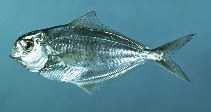
Spine dorsali (totale) : 3; Spine anali: 3. This species is distinguished by the following characters: body oval to somewhat elongate, moderately deep (its depth 2.7 to 3 times in total length) and strongly compressed; eye medium-sized (its diameter 3.4 to 3.7 times in head length), surrounded by a small area of adipose tissue; snout short and blunt, lower jaw projecting somewhat beyond upper; mouth small, tip of maxillary not reaching to anterior eye margin; teeth in jaws very small, in a single row, while those in the upper jaw flattened and with 3 tiny cusps; dorsal and anal-fin bases very long (about equal in length), the anterior fin rays elevated, but fins not falcate, and both fins preceded by 3 short, weak, spines; caudal fin deeply forked; pectoral fins long (longer than head) and pointed; pelvic fins absent; a conspicuous series of 17 to 25 pores along anterior half of body under dorsal fin; lateral line high, following dorsal profile; scales small, present also on cheeks; caudal vertebrae 17 to 20; body color pale blue above, silvery below; numerous irregular dark spots on sides in live fish (fading after death) (Ref. 53006).
Body shape (shape guide): fusiform / normal; Cross section: compressed.
Forms large schools over the continental shelf, except during the winter months when it may descend to deeper water. Juveniles are generally found under floating weeds and jellyfish. Often found in brackish waters (Ref. 26938). Nerito-pelagic (Ref. 58426). Adults feeds mainly on jellyfish (Ref. 26938), squids, arrow worms, crustaceans and worms (Ref. 58426). Marketed fresh, smoked and frozen; eaten fried, broiled and baked (Ref. 9988). Mostly frozen and exported to Japan.
Robins, C.R. and G.C. Ray, 1986. A field guide to Atlantic coast fishes of North America. Houghton Mifflin Company, Boston, U.S.A. 354 p. (Ref. 7251)
Stato della Lista Rossa IUCN (Ref. 130435: Version 2025-2 (Global))
Minaccia per l'uomo
Harmless
Usi umani
Pesca: commerciale; Pesce da pesca sportiva: si
Strumenti
Rapporti speciali
Scarica XML
Fonti Internet
Stime basate su modelli
Temperatura preferita (Fonte Biblio.
123201): 5.1 - 24.7, mean 21.7 °C (based on 250 cells).
Indice di diversità filogenetica (Fonte Biblio.
82804): PD
50 = 0.5020 [Uniqueness, from 0.5 = low to 2.0 = high].
Bayesian length-weight: a=0.01230 (0.00874 - 0.01732), b=3.14 (3.04 - 3.24), in cm total length, based on LWR estimates for this species (Ref.
93245).
Livello trofico (Fonte Biblio.
69278): 3.9 ±0.0 se; based on diet studies.
Resilienza (Fonte Biblio.
120179): Alto, tempo minimo di raddoppiamento della popolazione meno di 15 mesi (K=0.8(?); tm=1).
Vulnerabilità della pesca (Ref.
59153): Low vulnerability (20 of 100).
🛈
Vulnerabilità climatica (Ref.
125649): Low vulnerability (22 of 100).
🛈
Nutrienti (Ref.
124155): Calcium = 72.3 [28.5, 163.3] mg/100g; Iron = 0.903 [0.420, 1.790] mg/100g; Protein = 18.2 [16.4, 19.7] %; Omega3 = 0.509 [0.299, 0.844] g/100g; Selenium = 40.4 [18.9, 79.2] μg/100g; VitaminA = 14.6 [4.9, 43.9] μg/100g; Zinc = 0.93 [0.59, 1.40] mg/100g (wet weight);