>
Holocentriformes (Squirrelfishes, soldierfishes) >
Holocentridae (Squirrelfishes, soldierfishes) > Holocentrinae
Etymology: Neoniphon: Greek, neos = new + Greek, niphon = to snow (Ref. 45335).
Entorno: milieu / zona climática / rango de profundidad / gama de distribución
Ecología
marino asociado a arrecife; rango de profundidad 0 - 46 m (Ref. 9710). Tropical; 30°N - 32°S, 31°E - 123°W
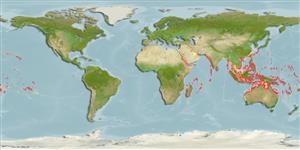
Indo-Pacific: Red Sea and East Africa to the Marquesan and Ducie islands, north to southern Japan, the Ogasawara and Hawaiian islands, south to northern Australia and Lord Howe Island.
Longitud en la primera madurez / Tamaño / Peso / Edad
Madurez: Lm 15.0 range ? - ? cm
Max length : 32.0 cm TL macho / no sexado; (Ref. 9710); common length : 23.0 cm TL macho / no sexado; (Ref. 9948)
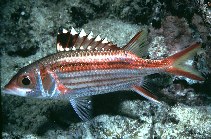
Espinas dorsales (total) : 11; Radios blandos dorsales (total) : 11 - 13; Espinas anales: 4; Radios blandos anales: 7 - 8. Pinkish silvery above, silvery below; a dark red to black spot on each scale. Reddish stripe along LL (Ref. 4201). Outer margin of caudal lobes and anterior soft rays of dorsal and anal fins reddish; pectoral fins pale pink, pelvic fins white (Ref. 4201).
Body shape (shape guide): fusiform / normal; Cross section: compressed.
This schooling species inhabits seagrass beds and hard-bottomed habitats from the reef flat to depths of 46 m or more on lagoon and seaward reefs. Often found with branching Acropora coral (Ref. 9710). Most common Neophion found in shallow areas (Ref. 9710). Benthopelagic (Ref. 58302). Feeds on small fishes (Ref. 30573), small crabs, and shrimps at night. Venomous spine at the corner of its preopercle. Marketed fresh (Ref. 9948). Solitary (Ref 90102).
Ciclo vital y comportamiento de apareamiento
Madurez | Reproducción | Puesta | Huevos | Fecundidad | Larva
Randall, J.E. and P.C. Heemstra, 1986. Holocentridae. p. 415-427. In M.M. Smith and P.C. Heemstra (eds.) Smiths' sea fishes. Springer-Verlag, Berlin. (Ref. 4201)
Situación en la Lista Roja de la UICN (Ref. 130435: Version 2025-2 (Global))
Amenaza para el ser humano
Usos humanos
Pesquerías: escaso valor comercial; Acuario: Comercial; carnada: usually
Herramientas
Informes especiales
Descargar XML
Fuentes de Internet
Estimaciones basadas en modelos
Temperatura preferida (Referencia
123201): 24.7 - 29, mean 27.9 °C (based on 954 cells).
Índice de diversidad filogenética (Referencia
82804): PD
50 = 0.5039 [Uniqueness, from 0.5 = low to 2.0 = high].
Bayesian length-weight: a=0.01622 (0.01327 - 0.01982), b=2.96 (2.90 - 3.02), in cm total length, based on LWR estimates for this species (Ref.
93245).
Nivel trófico (Referencia
69278): 3.6 ±0.2 se; based on diet studies.
Generation time: 3.9 ( na - na) years. Estimated as median ln(3)/K based on 2
growth studies.
Resiliencia (Referencia
120179): Alto, población duplicada en un tiempo mínimo inferior a 15 meses (K=0.5).
Vulnerabilidad pesquera (Ref.
59153): Low to moderate vulnerability (26 of 100).
🛈
Nutrientes (Ref.
124155): Calcium = 52.1 [24.2, 156.6] mg/100g; Iron = 0.62 [0.26, 1.24] mg/100g; Protein = 18.6 [17.5, 19.8] %; Omega3 = 0.157 [0.065, 0.357] g/100g; Selenium = 32.8 [20.6, 58.8] μg/100g; VitaminA = 75.4 [30.1, 192.0] μg/100g; Zinc = 1.21 [0.80, 1.83] mg/100g (wet weight);