>
Holocentriformes (Squirrelfishes, soldierfishes) >
Holocentridae (Squirrelfishes, soldierfishes) > Holocentrinae
Etymology: Neoniphon: Greek, neos = new + Greek, niphon = to snow (Ref. 45335).
Environnement : milieu / zone climatique / profondeur / gamme de distribution
Écologie
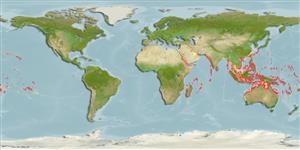
marin récifal; profondeur 0 - 46 m (Ref. 9710). Tropical; 30°N - 32°S, 31°E - 123°W
Indo-Pacific: Red Sea and East Africa to the Marquesan and Ducie islands, north to southern Japan, the Ogasawara and Hawaiian islands, south to northern Australia and Lord Howe Island.
Longueur à la première maturité / Taille / Poids / Âge
Maturité: Lm 15.0 range ? - ? cm
Max length : 32.0 cm TL mâle / non sexé; (Ref. 9710); common length : 23.0 cm TL mâle / non sexé; (Ref. 9948)
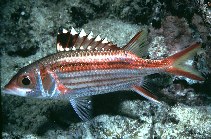
Épines dorsales (Total) : 11; Rayons mous dorsaux (Total) : 11 - 13; Épines anales: 4; Rayons mous anaux: 7 - 8. Pinkish silvery above, silvery below; a dark red to black spot on each scale. Reddish stripe along LL (Ref. 4201). Outer margin of caudal lobes and anterior soft rays of dorsal and anal fins reddish; pectoral fins pale pink, pelvic fins white (Ref. 4201).
Body shape (shape guide): fusiform / normal; Cross section: compressed.
This schooling species inhabits seagrass beds and hard-bottomed habitats from the reef flat to depths of 46 m or more on lagoon and seaward reefs. Often found with branching Acropora coral (Ref. 9710). Most common Neophion found in shallow areas (Ref. 9710). Benthopelagic (Ref. 58302). Feeds on small fishes (Ref. 30573), small crabs, and shrimps at night. Venomous spine at the corner of its preopercle. Marketed fresh (Ref. 9948). Solitary (Ref 90102).
Cycle de vie et comportement reproducteur
Maturité | Reproduction | Frai | Œufs | Fécondité | Larves
Randall, J.E. and P.C. Heemstra, 1986. Holocentridae. p. 415-427. In M.M. Smith and P.C. Heemstra (eds.) Smiths' sea fishes. Springer-Verlag, Berlin. (Ref. 4201)
Statut dans la liste rouge de l'IUCN (Ref. 130435: Version 2025-2 (Global))
Utilisations par l'homme
Pêcheries: intérêt commercial mineur; Aquarium: Commercial; appât: usually
Outils
Articles particuliers
Télécharger en XML
Sources Internet
Estimations basées sur des modèles
Température préférée (Réf.
123201): 24.7 - 29, mean 27.9 °C (based on 954 cells).
Indice de diversité phylogénétique (Réf.
82804): PD
50 = 0.5039 [Uniqueness, from 0.5 = low to 2.0 = high].
Bayesian length-weight: a=0.01622 (0.01327 - 0.01982), b=2.96 (2.90 - 3.02), in cm total length, based on LWR estimates for this species (Ref.
93245).
Niveau trophique (Réf.
69278): 3.6 ±0.2 se; based on diet studies.
Generation time: 3.9 ( na - na) years. Estimated as median ln(3)/K based on 2
growth studies.
Résilience (Réf.
120179): Haut, temps minimum de doublement de population inférieur à 15 mois (K=0.5).
Vulnérabilité de la pêche (Ref.
59153): Low to moderate vulnerability (26 of 100).
🛈
Nutriments (Ref.
124155): Calcium = 52.1 [24.2, 156.6] mg/100g; Iron = 0.62 [0.26, 1.24] mg/100g; Protein = 18.6 [17.5, 19.8] %; Omega3 = 0.157 [0.065, 0.357] g/100g; Selenium = 32.8 [20.6, 58.8] μg/100g; VitaminA = 75.4 [30.1, 192.0] μg/100g; Zinc = 1.21 [0.80, 1.83] mg/100g (wet weight);