Taxonomic Remarks
Pampus cinereus is considered a valid species according to Liu et al., 2013 (Ref. 95516) and P. liuorum Liu & Li, 2013 (Ref. 95101) is a junior synonym of Pampus cinereus according to Yin et al., 2019 (Ref. 123875).
Περιβάλλον: περιβάλλον / κλιματική ζώνη / εύρος βάθους / εύρος διανομής
Οικολογία
Θαλασσινό(ά) βενθοπελαγικό; ωκεανόδρομο(ς) (Ref. 51243); εύρος βάθους 5 - 110 m (Ref. 12260). Subtropical; 46°N - 10°S, 47°E - 142°E
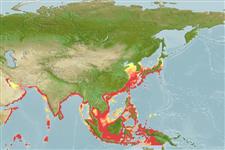
Indo-West Pacific: Persian Gulf to Indonesia, north to Hokkaido, Japan. Extralimital captures have been made from the Adriatic and off Hawaii. Not recorded from Australasia. Northeastern Atlantic: 3 reports of capture reported from this area (Ref. 86350).
Μήκος κατά την πρώτη ωρίμανση / Μέγεθος / Βάρος / Ηλικία
Γεννητική Ωρίμανση: Lm 25.3, range 18 - ? cm
Max length : 60.0 cm SL αρσενικό/απροσδιόριστο; (Ref. 9811); common length : 30.0 cm SL αρσενικό/απροσδιόριστο; (Ref. 9811); μεγ. αναφερόμενη ηλικία: 7 έτη (Ref. 45538)
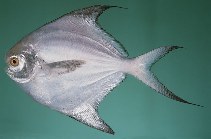
Ραχιαίες άκανθες (συνολικά) : 0; Μαλακές ραχιαίες ακτίνες (συνολικά) : 37 - 43; Σπόνδυλοι: 34 - 37. Body firm, very deep, oval, and compressed. Operculum absent; gill opening reduced to a vertical slit on the side of the body; gill membrane broadly united to isthmus. Dorsal and anal fins preceded by a series of 5 to 10 blade-like spines with anterior and posterior points. Pelvic fins absent. Caudal fin deeply forked, the lower lobe longer than the upper. Color is gray above grading to silvery white towards the belly, with small black dots all over the body. Fins are faintly yellow; vertical fins with dark edges.
Body shape (shape guide): short and / or deep; Cross section: compressed.
Inshore species, usually in schools over muddy bottoms, associated with fish species like Nemipterus and Leiognathus. Adults feed on ctenophores, salps, medusae, and other zooplankton groups. Western populations spawn from late winter through the summer with peaks from April to June. Sold fresh in local markets or shipped frozen to urban centers. Used in Chinese medicine (Ref. 12166).
Haedrich, R.L., 1984. Stromateidae. In W. Fischer and G. Bianchi (eds.) FAO species identification sheets for fishery purposes. Western Indian Ocean (Fishing Area 51). Vol. 4. FAO, Rome. pag. var. (Ref. 3517)
Κατάσταση Κόκκινου Καταλόγου IUCN (Ref. 130435: Version 2025-2 (Global))
Απειλή για τον άνθρωπο
Harmless
Ανθρώπινες χρήσεις
αλιεία: πολύ εμπορικό
Εργαλεία
Ειδικές εκθέσεις
Λήψη XML
Διαδικτυακές πηγές
Εκτιμήσεις βάσει μοντέλων
Προτιμώμενη θερμοκρασία (Αναφ.
123201): 21.9 - 29.1, mean 28.1 °C (based on 1636 cells).
Δείκτης φυλογενετικής ποικιλότητας (Αναφ.
82804): PD
50 = 0.5313 [Uniqueness, from 0.5 = low to 2.0 = high].
Bayesian length-weight: a=0.01820 (0.01399 - 0.02367), b=3.02 (2.95 - 3.09), in cm total length, based on LWR estimates for this species (Ref.
93245).
Τροφικό Επίπεδο (Αναφ.
69278): 3.3 ±0.1 se; based on diet studies.
Ελαστικότητα (Αναφ.
120179): Μεσαίο(α), ελάχιστος χρόνος για διπλασιασμό πληθυσμού 1,4 - 4,4 έτη (K=0.24-0.26; tmax=7; Fec=5,470).
Prior r = 0.57, 95% CL = 0.37 - 0.85, Based on 9 data-limited stock assessments.
Ευπάθεια στην αλιεία (Ref.
59153): Low to moderate vulnerability (31 of 100).
🛈
Ευπάθεια στο κλίμα (Ref.
125649): Moderate to high vulnerability (48 of 100).
🛈
Θρεπτικά συστατικά (Ref.
124155): Calcium = 30.2 [12.9, 71.1] mg/100g; Iron = 0.423 [0.222, 1.065] mg/100g; Protein = 18 [17, 19] %; Omega3 = 0.264 [0.154, 0.448] g/100g; Selenium = 68.2 [22.3, 198.9] μg/100g; VitaminA = 7.21 [1.85, 26.63] μg/100g; Zinc = 0.442 [0.263, 0.770] mg/100g (wet weight); based on
nutrient studies.