Taxonomic Remarks
Pampus cinereus is considered a valid species according to Liu et al., 2013 (Ref. 95516) and P. liuorum Liu & Li, 2013 (Ref. 95101) is a junior synonym of Pampus cinereus according to Yin et al., 2019 (Ref. 123875).
Environnement : milieu / zone climatique / profondeur / gamme de distribution
Écologie
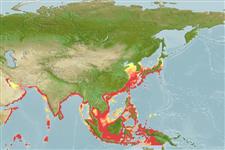
marin benthopélagique; océanodrome (Ref. 51243); profondeur 5 - 110 m (Ref. 12260). Subtropical; 46°N - 10°S, 47°E - 142°E
Indo-West Pacific: Persian Gulf to Indonesia, north to Hokkaido, Japan. Extralimital captures have been made from the Adriatic and off Hawaii. Not recorded from Australasia. Northeastern Atlantic: 3 reports of capture reported from this area (Ref. 86350).
Longueur à la première maturité / Taille / Poids / Âge
Maturité: Lm 25.3, range 18 - ? cm
Max length : 60.0 cm SL mâle / non sexé; (Ref. 9811); common length : 30.0 cm SL mâle / non sexé; (Ref. 9811); âge max. reporté: 7 années (Ref. 45538)
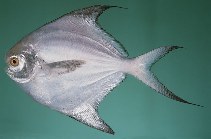
Épines dorsales (Total) : 0; Rayons mous dorsaux (Total) : 37 - 43; Vertèbres: 34 - 37. Body firm, very deep, oval, and compressed. Operculum absent; gill opening reduced to a vertical slit on the side of the body; gill membrane broadly united to isthmus. Dorsal and anal fins preceded by a series of 5 to 10 blade-like spines with anterior and posterior points. Pelvic fins absent. Caudal fin deeply forked, the lower lobe longer than the upper. Color is gray above grading to silvery white towards the belly, with small black dots all over the body. Fins are faintly yellow; vertical fins with dark edges.
Body shape (shape guide): short and / or deep; Cross section: compressed.
Inshore species, usually in schools over muddy bottoms, associated with fish species like Nemipterus and Leiognathus. Adults feed on ctenophores, salps, medusae, and other zooplankton groups. Western populations spawn from late winter through the summer with peaks from April to June. Sold fresh in local markets or shipped frozen to urban centers. Used in Chinese medicine (Ref. 12166).
Haedrich, R.L., 1984. Stromateidae. In W. Fischer and G. Bianchi (eds.) FAO species identification sheets for fishery purposes. Western Indian Ocean (Fishing Area 51). Vol. 4. FAO, Rome. pag. var. (Ref. 3517)
Statut dans la liste rouge de l'IUCN (Ref. 130435: Version 2025-2 (Global))
Menace pour l'homme
Harmless
Utilisations par l'homme
Pêcheries: hautement commercial
Outils
Articles particuliers
Télécharger en XML
Sources Internet
Estimations basées sur des modèles
Température préférée (Réf.
123201): 21.9 - 29.1, mean 28.1 °C (based on 1636 cells).
Indice de diversité phylogénétique (Réf.
82804): PD
50 = 0.5313 [Uniqueness, from 0.5 = low to 2.0 = high].
Bayesian length-weight: a=0.01820 (0.01399 - 0.02367), b=3.02 (2.95 - 3.09), in cm total length, based on LWR estimates for this species (Ref.
93245).
Niveau trophique (Réf.
69278): 3.3 ±0.1 se; based on diet studies.
Résilience (Réf.
120179): Milieu, temps minimum de doublement de population : 1,4 à 4,4 années (K=0.24-0.26; tmax=7; Fec=5,470).
Prior r = 0.57, 95% CL = 0.37 - 0.85, Based on 9 data-limited stock assessments.
Vulnérabilité de la pêche (Ref.
59153): Low to moderate vulnerability (31 of 100).
🛈
Vulnérabilité climatique (Ref.
125649): Moderate to high vulnerability (48 of 100).
🛈
Nutriments (Ref.
124155): Calcium = 30.2 [12.9, 71.1] mg/100g; Iron = 0.423 [0.222, 1.065] mg/100g; Protein = 18 [17, 19] %; Omega3 = 0.264 [0.154, 0.448] g/100g; Selenium = 68.2 [22.3, 198.9] μg/100g; VitaminA = 7.21 [1.85, 26.63] μg/100g; Zinc = 0.442 [0.263, 0.770] mg/100g (wet weight); based on
nutrient studies.