>
Gobiiformes (Gobies) >
Gobiidae (Gobies) > Gobiinae
Etymology: Neogobius: Greek, neos = new + Latin, gobius = gudgeon (Ref. 45335).
Eponymy: Peter Simon Pallas (1741–1811) was a German-born Russian (1767) explorer, zoologist and one of greatest 18th century naturalists. [...] (Ref. 128868), visit book page.
More on author: Berg.
Ambiente: milieu / zona climática / intervalo de profundidade / gama de distribuição
Ecologia
; Água doce bentopelágico. Temperate
Europe and Asia: Caspian basin; common in Volga drainage, upriver to Moscow. Introduced in Aral basin.
Tamanho / Peso / Idade
Maturidade: Lm ? range ? - ? cm
Max length : 20.0 cm SL macho/indeterminado; (Ref. 59043)
Descrição breve
Chaves de identificação | Morfologia | Morfometria
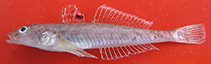
This species is distinguished from its congeners entering freshwater in the Caspian Sea basin by the following characters: first branched ray of second dorsal about as long as penultimate ray; nape completely scaled; pelvic-disc fraenum with small rounded lobes and the length is less than 1/6 of width at base; pelvic disc reaching 90-100% of distance between its origin and anus; scales in midlateral series 55-63 + 2-3; in juveniles at least, posterior part of first dorsal with black spot (Ref. 59043).
Body shape (shape guide): fusiform / normal.
Occurs in lagoons and lakes, large- to medium- size rivers, on sand or mud bottom; usually on open sand or sand-shell bottom. Lives up to 3 years. Spawns for the first time at 1 year, rarely at 2. Spawns in April-September. Individual females may repeat spawning during a season. Adhesive eggs are deposited on stones, shells and aquatic plants and are guarded by males until hatching. Feeds on a wide variety of invertebrates (mainly crustaceans and insect larvae) and small fish (Ref.59043). Is the most important commercial species of goby in the Caspian Sea (Ref. 2058).
Ciclo de vida e comportamento de acasalamento
Maturidade | Reprodução | Desova | Ovos | Fecundidade | Larvas
Kottelat, M. and J. Freyhof, 2007. Handbook of European freshwater fishes. Publications Kottelat, Cornol and Freyhof, Berlin. 646 pp. (Ref. 59043)
Categoria na Lista Vermelha da IUCN (Ref. 130435: Version 2025-2 (Global))
Ameaça para o homem
Harmless
Utilização humana
Pescarias: espécies comerciais
Ferramentas
Relatórios especiais
Descarregue XML
Fontes da internet
Estimativas baseadas em modelos
Índice de diversidade filogenética (Ref.
82804): PD
50 = 0.5625 [Uniqueness, from 0.5 = low to 2.0 = high].
Bayesian length-weight: a=0.01023 (0.00477 - 0.02194), b=3.01 (2.83 - 3.19), in cm total length, based on LWR estimates for this (Sub)family-body shape (Ref.
93245).
Nível Trófico (Ref.
69278): 3.3 ±0.1 se; based on size and trophs of closest relatives
Resiliência (Ref.
120179): Médio, tempo mínimo de duplicação da população 1,4 - 4,4 anos (Preliminary K or Fecundity.).
Vulnerabilidade da pesca (Ref.
59153): Low vulnerability (14 of 100).
🛈