Klassifizierung / Names
Namen | Synonyme | Catalog of Fishes(Gattung, Arten) | ITIS | CoL | WoRMS | Cloffa
>
Gobiiformes (Gobies) >
Gobiidae (Gobies) > Gobiinae
Etymology: Neogobius: Greek, neos = new + Latin, gobius = gudgeon (Ref. 45335).
Eponymy: Peter Simon Pallas (1741–1811) was a German-born Russian (1767) explorer, zoologist and one of greatest 18th century naturalists. [...] (Ref. 128868), visit book page.
More on author: Berg.
Umwelt: Milieu / Klimazone / Tiefenbereich / Verbreitungsgebiet
Ökologie
; süßwasser benthopelagisch. Temperate
Europe and Asia: Caspian basin; common in Volga drainage, upriver to Moscow. Introduced in Aral basin.
Größe / Gewicht / Alter
Geschlechtsreife: Lm ? range ? - ? cm
Max length : 20.0 cm SL Männchen/unbestimmt; (Ref. 59043)
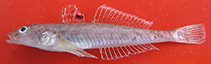
This species is distinguished from its congeners entering freshwater in the Caspian Sea basin by the following characters: first branched ray of second dorsal about as long as penultimate ray; nape completely scaled; pelvic-disc fraenum with small rounded lobes and the length is less than 1/6 of width at base; pelvic disc reaching 90-100% of distance between its origin and anus; scales in midlateral series 55-63 + 2-3; in juveniles at least, posterior part of first dorsal with black spot (Ref. 59043).
Body shape (shape guide): fusiform / normal.
Occurs in lagoons and lakes, large- to medium- size rivers, on sand or mud bottom; usually on open sand or sand-shell bottom. Lives up to 3 years. Spawns for the first time at 1 year, rarely at 2. Spawns in April-September. Individual females may repeat spawning during a season. Adhesive eggs are deposited on stones, shells and aquatic plants and are guarded by males until hatching. Feeds on a wide variety of invertebrates (mainly crustaceans and insect larvae) and small fish (Ref.59043). Is the most important commercial species of goby in the Caspian Sea (Ref. 2058).
Lebenszyklus und Paarungsverhalten
Geschlechtsreife | Fortpflanzung | Ablaichen | Eier | Fruchtbarkeit | Larven
Kottelat, M. and J. Freyhof, 2007. Handbook of European freshwater fishes. Publications Kottelat, Cornol and Freyhof, Berlin. 646 pp. (Ref. 59043)
IUCN Rote Liste Status (Ref. 130435: Version 2025-2 (Global))
Bedrohung für Menschen
Harmless
Nutzung durch Menschen
Fischereien: kommerziell
Tools
Zusatzinformationen
Download XML
Internet Quellen
Schätzungen auf der Grundlage von Modellen
Phylogenetischer Diversitätsindex (Ref.
82804): PD
50 = 0.5625 [Uniqueness, from 0.5 = low to 2.0 = high].
Bayesian length-weight: a=0.01023 (0.00477 - 0.02194), b=3.01 (2.83 - 3.19), in cm total length, based on LWR estimates for this (Sub)family-body shape (Ref.
93245).
Trophische Ebene (Ref.
69278): 3.3 ±0.1 se; based on size and trophs of closest relatives
Widerstandsfähigkeit (Ref.
120179): mittel, Verdopplung der Population dauert 1,4 - 4,4 Jahre. (Preliminary K or Fecundity.).
Anfälligkeit der Fischerei (Ref.
59153): Low vulnerability (14 of 100).
🛈