>
Salmoniformes (Salmons) >
Salmonidae (Salmonids) > Coregoninae
Etymology: Coregonus: Greek, kore = pupils of the eye + Greek, gonia = angle (Ref. 45335).
More on author: Bloch.
Môi trường: môi trường / vùng khí hậu / Mức độ sâu / phạm vi phân phối
Sinh thái học
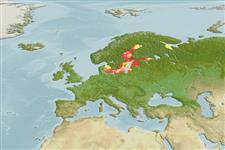
biển; nước ngọt; thuộc về nước lợ gần đáy; di cư biển sông (để đẻ trứng) (Ref. 88171); mức độ sâu 10 - 20 m (Ref. 130226). Temperate; 69°N - 49°N, 7°E - 37°E (Ref. 59043)
Europe: In the Baltic Sea: Swedish coast (including Bothnian Gulf, not in Gotland); in southern Baltic, extending from the Schlei to Gulf of Finland. Southeast North Sea Basin: Ems, Weser and Elbe drainages and small rivers of Schleswig-Holstein and Denmark. Landlocked in several lakes in Poland, Sweden, and Russia. Introduced and transplanted in many drainages within its native range and outside westward to Rhine drainage (Ref. 59043). Apparent abundance in Germany, Poland and Scandinavia results from the massive stocking programs without which the populations would rapidly decline.
Usually known as C. lavaretus in the Baltic Sea basin. North Sea population might represent a distinct species (Ref. 59043).
Bộ gần gũi / Khối lượng (Trọng lượng) / Tuổi
Chín muồi sinh dục: Lm ? range ? - ? cm
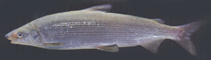
Max length : 130 cm TL con đực/không giới tính; (Ref. 593); Khối lượng cực đại được công bố: 10.0 kg (Ref. 593)
Mô tả ngắn gọn
Khóa để định loại | Hình thái học | Sinh trắc học
Forages along coasts. Also reported from deep, oligo-mesotrophic lakes. Feeds on benthic prey (crustaceans, molluscs, large insect larvae, small fish). Spawns in shallow water, in rapids or small rivers or over firm sediments in lowland rivers and estuaries. Northernmost stocks undertake the longest migrations between spawning and foraging grounds. In the northern part of the range, individuals may travel as much as 700 km between these areas (Ref. 59043).
Growth parameters from Russia suggest a maximum age of 20 years (Ref. 56506) .
Members of the genus Coregonus readily hybridise with other Coregonus species and populations (Ref. 89548).
Adults ascend rivers between June and October (northern Baltic) or November (southern Baltic), when water temperature drops below 10 °C.
Spawning occurs in estuarine areas with low salinities or lower reaches of rivers or rapids (Ref. 59043). Coregonus species spawn on gravel and sand bottoms (Ref. 35387). Spawns for the first time at 3-5 years. Some females spawn only every second year (Ref. 59043). Spawners may spend the winter in rivers or near estuaries along the coast (Ref. 89484). Eggs hatch in early spring and larvae drift downstream to estuarine bays or to the sea; juveniles migrate to the sea in summer (Ref. 59043).
Kottelat, M., 1997. European freshwater fishes. An heuristic checklist of the freshwater fishes of Europe (exclusive of former USSR), with an introduction for non-systematists and comments on nomenclature and conservation. Biologia, Bratislava, 52/Suppl. 5:1-271. (Ref. 13696)
Tình trạng Sách đỏ IUCN (Ref. 130435: Version 2025-2 (Global))
Mối đe dọa đối với con người
Harmless
Sử dụng của con người
Các nghề cá: buôn bán nhỏ; Nuôi trồng thủy sản: tính thương mại
Các công cụ
Báo cáo đặc biệt
Tải xuống XML
Các nguồn internet
Ước tính dựa trên mô hình
Nhiệt độ ưa thích (Tài liệu tham khảo
123201): 4.5 - 9.7, mean 7.5 °C (based on 174 cells).
Chỉ số đa dạng phát sinh loài (Tài liệu tham khảo
82804): PD
50 = 0.5000 [Uniqueness, from 0.5 = low to 2.0 = high].
Bayesian length-weight: a=0.00550 (0.00333 - 0.00907), b=3.20 (3.06 - 3.34), in cm total length, based on LWR estimates for this species & Genus-body shape (Ref.
93245).
Mức dinh dưỡng (Tài liệu tham khảo
69278): 3.5 ±0.3 se; based on size and trophs of closest relatives
Thích nghi nhanh (Tài liệu tham khảo
120179): Trung bình, thời gian nhân đôi của chủng quần tối thiểu là 1.4 - 4.4 năm (tm=2-3).
Sự dễ bị tổn thương của nghề đánh cá (Ref.
59153): Very high vulnerability (78 of 100).
🛈