>
Salmoniformes (Salmons) >
Salmonidae (Salmonids) > Coregoninae
Etymology: Coregonus: Greek, kore = pupils of the eye + Greek, gonia = angle (Ref. 45335).
More on author: Bloch.
Milieu: milieu / Klimaatzone / Diepte / verspreidingsgebied
Ecologie
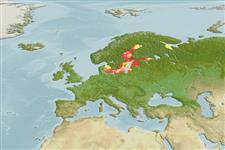
marien; zoet water; brak water demersaal; anadroom (Ref. 88171); diepte 10 - 20 m (Ref. 130226). Temperate; 69°N - 49°N, 7°E - 37°E (Ref. 59043)
Europe: In the Baltic Sea: Swedish coast (including Bothnian Gulf, not in Gotland); in southern Baltic, extending from the Schlei to Gulf of Finland. Southeast North Sea Basin: Ems, Weser and Elbe drainages and small rivers of Schleswig-Holstein and Denmark. Landlocked in several lakes in Poland, Sweden, and Russia. Introduced and transplanted in many drainages within its native range and outside westward to Rhine drainage (Ref. 59043). Apparent abundance in Germany, Poland and Scandinavia results from the massive stocking programs without which the populations would rapidly decline.
Usually known as C. lavaretus in the Baltic Sea basin. North Sea population might represent a distinct species (Ref. 59043).
Grootte / Gewicht / Leeftijd
Maturiteit: Lm ? range ? - ? cm
Max length : 130 cm TL mannelijk / geslacht onbekend; (Ref. 593); max. gepubliceerd gewicht: 10.0 kg (Ref. 593)
Korte beschrijving
Determinatiesleutels | Morfologie | Morfometrie
Forages along coasts. Also reported from deep, oligo-mesotrophic lakes. Feeds on benthic prey (crustaceans, molluscs, large insect larvae, small fish). Spawns in shallow water, in rapids or small rivers or over firm sediments in lowland rivers and estuaries. Northernmost stocks undertake the longest migrations between spawning and foraging grounds. In the northern part of the range, individuals may travel as much as 700 km between these areas (Ref. 59043).
Growth parameters from Russia suggest a maximum age of 20 years (Ref. 56506) .
Members of the genus Coregonus readily hybridise with other Coregonus species and populations (Ref. 89548).
Adults ascend rivers between June and October (northern Baltic) or November (southern Baltic), when water temperature drops below 10 °C.
Spawning occurs in estuarine areas with low salinities or lower reaches of rivers or rapids (Ref. 59043). Coregonus species spawn on gravel and sand bottoms (Ref. 35387). Spawns for the first time at 3-5 years. Some females spawn only every second year (Ref. 59043). Spawners may spend the winter in rivers or near estuaries along the coast (Ref. 89484). Eggs hatch in early spring and larvae drift downstream to estuarine bays or to the sea; juveniles migrate to the sea in summer (Ref. 59043).
Kottelat, M., 1997. European freshwater fishes. An heuristic checklist of the freshwater fishes of Europe (exclusive of former USSR), with an introduction for non-systematists and comments on nomenclature and conservation. Biologia, Bratislava, 52/Suppl. 5:1-271. (Ref. 13696)
Status op de Rode Lijst van het IUCN (Ref. 130435: Version 2025-2 (Global))
Gevaar voor de mens
Harmless
Gebruik door de mens
Visserij: van minder commercieel belang; Aquacultuur: commercieel
Tools
Speciale rapporten
Download XML
Internetbronnen
Schattingen op basis van modellen
Gewenste temperatuur (Ref.
123201): 4.5 - 9.7, mean 7.5 °C (based on 174 cells).
Fylogenetische diversiteitsindex (Ref.
82804): PD
50 = 0.5000 [Uniqueness, from 0.5 = low to 2.0 = high].
Bayesian length-weight: a=0.00550 (0.00333 - 0.00907), b=3.20 (3.06 - 3.34), in cm total length, based on LWR estimates for this species & Genus-body shape (Ref.
93245).
Trofisch niveau (Ref.
69278): 3.5 ±0.3 se; based on size and trophs of closest relatives
Weerstandsvermogen (Ref.
120179): Gemiddeld, minimale populatieverdubbelingstijd 1,4-4,4 jaar (tm=2-3).
Kwetsbaarheid van de visserij (Ref.
59153): Very high vulnerability (78 of 100).
🛈