Klassifizierung / Names
Namen | Synonyme | Catalog of Fishes(Gattung, Arten) | ITIS | CoL | WoRMS | Cloffa
>
Cypriniformes (Carps) >
Danionidae (Danios) > Danioninae
Etymology: Devario: Bangla/Bengali:‘debari’, local name for these fishes; also meaning ‘brother in law’ (Ref. 2031).
More on author: Jerdon.
Umwelt: Milieu / Klimazone / Tiefenbereich / Verbreitungsgebiet
Ökologie
; süßwasser benthopelagisch. Tropical; 18°C - 25°C; 22°N - 6°N, 72°E - 81°E
Asia: west coast of India and Sri Lanka. Has been widely transported around the world through the aquarium fish trade industry.
Größe / Gewicht / Alter
Geschlechtsreife: Lm ? range ? - ? cm
Max length : 12.0 cm TL Männchen/unbestimmt; (Ref. 41236); common length : 8.0 cm TL Männchen/unbestimmt; (Ref. 6028)
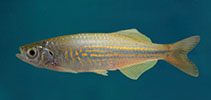
Rückenflossenweichstrahlen (insgesamt) : 12 - 16; Afterflossenweichstrahlen: 15 - 20; Wirbelzahl: 34 - 36. Devario malabaricus differs from all its congeners by the combination of the following characters: absence of process on 1st infraorbital; body depth 27-35 %SL; predorsal scales15-17; dorsal fin with 11½-12½ branched rays; anal fin with 12½-17½ branched rays; presence of danionin notch; origin of dorsal fin to hypural distance when carried forward falling well short of posterior border of eye; tip of pectoral fin almost reaching origin of pelvic fin when adpressed; snout length subequal to or greater than eye diameter; P stripe originating level with pelvic-fin origin, 1-2 scale-widths anterior to dorsal-fin origin; P-1 stripe less than half width of P stripe, bifurcated anteriorly by a more or less broken whitish line; 5-6 dark, irregular, vertical bars on the anterior half of body; and absence of nuptial tubercles in both sexes (ref. 118056).
Body shape (shape guide): fusiform / normal.
Found in a variety of habitats from boulder-strewn mountain torrents to small pools in dry zone streams. Most common in flowing water than in reservoirs and tanks. Adults form medium sized shoals and prefer flowing water. They feed on terrestrial insects and detritus. They spawn in shallow water, among marginal weeds and roots usually after heavy rains. Eggs are light orange and sticky; more than 200 eggs are laid and hatch in 1-2 days. Fry are free-swimming on fifth day. They exhibit cannibalism on eggs (Ref. 6028). Individuals rarely reach 12 cm (Ref. 41236). Migratory behaviour is undetermined (Ref. 126106).
Lebenszyklus und Paarungsverhalten
Geschlechtsreife | Fortpflanzung | Ablaichen | Eier | Fruchtbarkeit | Larven
Spawns in shallow water, among marginal weeds and roots usually after heavy rains. Eggs are light orange and sticky; more than 200 eggs are laid and hatch in 1-2 days. Fry are free-swimming on fifth day. Exhibits cannibalism on eggs (Ref. 6028).
Kullander, F.F., 2001. Phylogeny and species diversity of the South and Southeast Asian cyprinid genus Danio Hamilton (Teleostei, Cyprinidae). Ph.D. Thesis-Stockholm University, Department of Zoology. p. 1-26. Sweden, Stockholm University. Department of Zoology. (Ref. 38392)
IUCN Rote Liste Status (Ref. 130435: Version 2025-2 (Global))
Bedrohung für Menschen
Harmless
Nutzung durch Menschen
Fischereien: nicht kommerziell; Aquarium: hoch kommerziell
Tools
Zusatzinformationen
Download XML
Internet Quellen
Schätzungen auf der Grundlage von Modellen
Phylogenetischer Diversitätsindex (Ref.
82804): PD
50 = 0.5000 [Uniqueness, from 0.5 = low to 2.0 = high].
Bayesian length-weight: a=0.00977 (0.00422 - 0.02262), b=3.04 (2.84 - 3.24), in cm total length, based on LWR estimates for this (Sub)family-body shape (Ref.
93245).
Trophische Ebene (Ref.
69278): 3.2 ±0.2 se; based on diet studies.
Widerstandsfähigkeit (Ref.
120179): hoch, Verdopplung der Population dauert weniger als 15 Monate. (tm<1; assuming multiple spawing events per year; Fec=200).
Anfälligkeit der Fischerei (Ref.
59153): Low vulnerability (10 of 100).
🛈