Περιβάλλον: περιβάλλον / κλιματική ζώνη / εύρος βάθους / εύρος διανομής
Οικολογία
; Γλυκού νερού; Υφάλμυρο βενθοπελαγικό; pH range: 7.0 - ? ; dH range: 10 - ?; ποταμόδρομος (Ref. 51243); εύρος βάθους 1 - ? m (Ref. 30578). Temperate; 10°C - 20°C (Ref. 2059); 68°N - 35°N, 6°W - 60°E
Europe and Asia: most of Europe north of Caucasus, Pyrénées and Alps, eastward to Ural and Emba. Naturally absent from Iberian Peninsula, Adriatic and Aegean basins (except Maritza drainage), Italy, Ireland, Great Britain (except southeast), Norway and Scandinavia north of 67°N, Caspian basin south of Volga. In Anatolia, Marmara basin. Locally introduced in Spain, Portugal and Italy. At least one country reports adverse ecological impact after introduction.
Μήκος κατά την πρώτη ωρίμανση / Μέγεθος / Βάρος / Ηλικία
Γεννητική Ωρίμανση: Lm 9.9, range 9 - ? cm
Max length : 25.0 cm TL αρσενικό/απροσδιόριστο; (Ref. 30578); common length : 15.0 cm TL αρσενικό/απροσδιόριστο; (Ref. 30578); μεγ. δημοσιευμένο βάρος: 60.00 g (Ref. 30578)
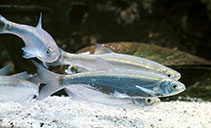
Ραχιαίες άκανθες (συνολικά) : 2 - 4; Μαλακές ραχιαίες ακτίνες (συνολικά) : 7 - 9; Εδρικές άκανθες: 3; Μαλακές εδρικές ακτίνες: 14 - 20; Σπόνδυλοι: 41 - 44. Diagnosed from congeners in Europe by the possession of the following characters: origin of anal fin below branched dorsal rays 4-5; lateral line with 45-48 + 3 scales; anal fin with 17-20½ branched rays; 16-22 gill rakers; ventral keel exposed from anus to pelvic base; lateral stripe absent in life, faint or absent in preserved specimens; and mouth slightly superior (Ref. 59043). Caudal fin with 19 rays (Ref. 2196). Also Ref. 40476.
Body shape (shape guide): fusiform / normal.
Inhabits open waters of lakes and medium to large rivers. Forms large aggregations in backwaters and other still waters during winter. Adults occur in shoals near the surface. Larvae live in littoral zone of rivers and lakes while juveniles leave shores and occupy a pelagic habitat, feeding on plankton, drifting insects or invertebrates fallen on the water surface (Ref. 59043). Feeds mainly on plankton, including crustaceans (Ref. 30578) and insects (Ref. 9696). Spawns in shallow riffles or along stony shores of lakes, occasionally above submerged vegetation (Ref. 59043). Excellent as bait for carnivorous fishes. May be captured using the smallest hook and a fly as bait. Its flesh is tasty (Ref. 30578). Of little interest to commercial or sport fisheries in its native range because of its small size (Ref. 1739). Scales were previously utilized in making Essence d"Orient, a coating for artificial pearls (Ref. 59043).
Eggs hatch in about 4 days (Ref. 59043).
Kottelat, M., 1997. European freshwater fishes. An heuristic checklist of the freshwater fishes of Europe (exclusive of former USSR), with an introduction for non-systematists and comments on nomenclature and conservation. Biologia, Bratislava, 52/Suppl. 5:1-271. (Ref. 13696)
Κατάσταση Κόκκινου Καταλόγου IUCN (Ref. 130435: Version 2025-2 (Global))
Ανθρώπινες χρήσεις
αλιεία: περιορισμένης εμπορικότητας; Υδατοκαλλιέργειες: Εμπορικό(ά); δόλωμα: usually
Εργαλεία
Ειδικές εκθέσεις
Λήψη XML
Διαδικτυακές πηγές
Εκτιμήσεις βάσει μοντέλων
Δείκτης φυλογενετικής ποικιλότητας (Αναφ.
82804): PD
50 = 0.5000 [Uniqueness, from 0.5 = low to 2.0 = high].
Bayesian length-weight: a=0.00562 (0.00484 - 0.00653), b=3.12 (3.09 - 3.15), in cm total length, based on LWR estimates for this species (Ref.
93245).
Τροφικό Επίπεδο (Αναφ.
69278): 2.7 ±0.29 se; based on food items.
Ελαστικότητα (Αναφ.
120179): Μεσαίο(α), ελάχιστος χρόνος για διπλασιασμό πληθυσμού 1,4 - 4,4 έτη (tm=2-3; K=0.19; tmax=7; Fec=1,500).
Ευπάθεια στην αλιεία (Ref.
59153): Low to moderate vulnerability (31 of 100).
🛈
Θρεπτικά συστατικά (Ref.
124155): Calcium = 80.3 [38.4, 133.1] mg/100g; Iron = 0.46 [0.27, 0.84] mg/100g; Protein = 16.7 [15.1, 18.1] %; Omega3 = 0.697 [0.310, 1.491] g/100g; Selenium = 9.19 [4.33, 19.16] μg/100g; VitaminA = 40.5 [14.0, 121.6] μg/100g; Zinc = 0.965 [0.689, 1.367] mg/100g (wet weight);