>
Blenniiformes (Blennies) >
Tripterygiidae (Triplefin blennies) > Tripterygiinae
Etymology: Norfolkia: Named for the Norfolk Island ( In 1953 Henry W. Fowler named this new genus on a Collection of Fishes Made by Dr. Marshall Laird at Norfolk Island) (R.Bajol, pers.comm. 04/2016).
Eponymy: Leonard R ‘Len’ Thomas was an Australian scientist who was Honorary Associate of the Australian Museum. He helped to plan, and accompanied, the Museum’s (1962) Swain Reefs Expedition, during which paratypes of the triplefin were collected. (Ref. 128868), visit book page.
More on author: Whitley.
Окружающая среда: среда / климатическая зона / пределы глубины / диапазон распространения
экология
морской ассоциированный с рифами; пределы глубины 1 - 20 m (Ref. 13227). Tropical
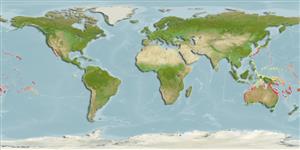
Western Pacific: From Ryukyu Is., Western Australia in the eastern Indian Ocean to New Caledonia, Rapa, the Tuamoto Archipelago and Mangaréva.
Размер / Вес / Возраст
половая зрелость: Lm ? range ? - ? cm
Max length : 5.0 cm SL самец/пол неопределен; (Ref. 54980)
Краткое описание
определительные ключи | морфология | морфометрия
колючие лучи спинного плавника (общее число) : 18 - 19; членистые (мягкие) лучи спинного плавника (общее число) : 9 - 11; колючие лучи анального плавника: 2; членистые (мягкие) лучи анального плавника: 20 - 22. Scales from head posteriorly to behind the eye but none on cheek; lobate supraorbital tentacle; body coloration white; yellow or orange on scale edges; 6 uneven, oblique, dark brown bands bifurcating ventrally; uneven brown bar below eye with white posterior border; females with thin, oblique, red and white bands on second and third dorsal fins; dull orange in males. Dorsal rays IV + XIV-XV + 9-11 (typically XV + 10); pectoral rays usually 15; lateral line discontinuous, 12-15 + 24-27; mandibular pores 3 + 2 + 3 (Ref. 54980).
Body shape (shape guide): elongated.
Adults are found in coral reefs and intertidal pools (Ref. 13227). Eggs are hemispherical and covered with numerous sticky threads that anchor them in the algae on the nesting sites (Ref. 240). Larvae are planktonic which occur primarily in shallow, nearshore waters (Ref. 94114).
Жизненный цикл и брачное поведение
половая зрелость | размножение | нерест | икра | Плодовитость | личинки
Fricke, R., 1994. Tripterygiid fishes of Australia, New Zealand and the southwest Pacific Ocean (Teleostei). Theses Zool. 24:1-585. (Ref. 13227)
Статус Красного Списка МСОП (Ref. 130435: Version 2025-2 (Global))
Угроза для людей
Harmless
Использование человеком
рыболовство: интереса не представляет
дополнительная информация
инструменты
Специальные отчеты
Скачать в формате XML
ресурсы в Интернет
Оценки, основанные на моделях
Предпочтительная температура (ссылка
123201): 23.3 - 28.6, mean 26.6 °C (based on 778 cells).
Индекс филогенетического разнообразия (ссылка
82804): PD
50 = 0.5625 [Uniqueness, from 0.5 = low to 2.0 = high].
Bayesian length-weight: a=0.00617 (0.00290 - 0.01310), b=3.04 (2.86 - 3.22), in cm total length, based on LWR estimates for this (Sub)family-body shape (Ref.
93245).
Трофический уровень (ссылка
69278): 3.2 ±0.4 se; based on size and trophs of closest relatives
устойчивость к внешним воздействиям (ссылка
120179): высокий, минимальное время удвоения популяции до 15 месяцев (Preliminary K or Fecundity.).
Уязвимость рыбной ловли (Ref.
59153): Low vulnerability (10 of 100).
🛈
Питательные вещества (Ref.
124155): Calcium = 319 [147, 835] mg/100g; Iron = 1.63 [0.72, 3.16] mg/100g; Protein = 18.3 [16.9, 19.7] %; Omega3 = 0.102 [0.039, 0.282] g/100g; Selenium = 45.1 [13.2, 133.4] μg/100g; VitaminA = 63.8 [14.5, 286.2] μg/100g; Zinc = 3.74 [2.00, 6.14] mg/100g (wet weight);