>
Blenniiformes (Blennies) >
Tripterygiidae (Triplefin blennies) > Tripterygiinae
Etymology: Norfolkia: Named for the Norfolk Island ( In 1953 Henry W. Fowler named this new genus on a Collection of Fishes Made by Dr. Marshall Laird at Norfolk Island) (R.Bajol, pers.comm. 04/2016).
Eponymy: Leonard R ‘Len’ Thomas was an Australian scientist who was Honorary Associate of the Australian Museum. He helped to plan, and accompanied, the Museum’s (1962) Swain Reefs Expedition, during which paratypes of the triplefin were collected. (Ref. 128868), visit book page.
More on author: Whitley.
Ambiente: milieu / zona climática / intervalo de profundidade / gama de distribuição
Ecologia
marinhas associadas(os) a recifes; intervalo de profundidade 1 - 20 m (Ref. 13227). Tropical
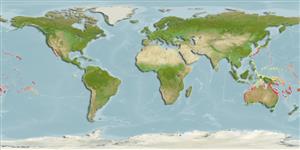
Western Pacific: From Ryukyu Is., Western Australia in the eastern Indian Ocean to New Caledonia, Rapa, the Tuamoto Archipelago and Mangaréva.
Tamanho / Peso / Idade
Maturidade: Lm ? range ? - ? cm
Max length : 5.0 cm SL macho/indeterminado; (Ref. 54980)
Descrição breve
Chaves de identificação | Morfologia | Morfometria
Espinhos dorsais (total) : 18 - 19; Raios dorsais moles (total) : 9 - 11; Espinhos anais: 2; Raios anais moles: 20 - 22. Scales from head posteriorly to behind the eye but none on cheek; lobate supraorbital tentacle; body coloration white; yellow or orange on scale edges; 6 uneven, oblique, dark brown bands bifurcating ventrally; uneven brown bar below eye with white posterior border; females with thin, oblique, red and white bands on second and third dorsal fins; dull orange in males. Dorsal rays IV + XIV-XV + 9-11 (typically XV + 10); pectoral rays usually 15; lateral line discontinuous, 12-15 + 24-27; mandibular pores 3 + 2 + 3 (Ref. 54980).
Body shape (shape guide): elongated.
Adults are found in coral reefs and intertidal pools (Ref. 13227). Eggs are hemispherical and covered with numerous sticky threads that anchor them in the algae on the nesting sites (Ref. 240). Larvae are planktonic which occur primarily in shallow, nearshore waters (Ref. 94114).
Ciclo de vida e comportamento de acasalamento
Maturidade | Reprodução | Desova | Ovos | Fecundidade | Larvas
Fricke, R., 1994. Tripterygiid fishes of Australia, New Zealand and the southwest Pacific Ocean (Teleostei). Theses Zool. 24:1-585. (Ref. 13227)
Categoria na Lista Vermelha da IUCN (Ref. 130435: Version 2025-2 (Global))
Ameaça para o homem
Harmless
Utilização humana
Pescarias: sem interesse
Ferramentas
Relatórios especiais
Descarregue XML
Fontes da internet
Estimativas baseadas em modelos
Temperatura preferida (Ref.
123201): 23.3 - 28.6, mean 26.6 °C (based on 778 cells).
Índice de diversidade filogenética (Ref.
82804): PD
50 = 0.5625 [Uniqueness, from 0.5 = low to 2.0 = high].
Bayesian length-weight: a=0.00617 (0.00290 - 0.01310), b=3.04 (2.86 - 3.22), in cm total length, based on LWR estimates for this (Sub)family-body shape (Ref.
93245).
Nível Trófico (Ref.
69278): 3.2 ±0.4 se; based on size and trophs of closest relatives
Resiliência (Ref.
120179): Elevada, tempo mínimo de duplicação da população menor que 15 meses (Preliminary K or Fecundity.).
Vulnerabilidade da pesca (Ref.
59153): Low vulnerability (10 of 100).
🛈
Nutrientes (Ref.
124155): Calcium = 319 [147, 835] mg/100g; Iron = 1.63 [0.72, 3.16] mg/100g; Protein = 18.3 [16.9, 19.7] %; Omega3 = 0.102 [0.039, 0.282] g/100g; Selenium = 45.1 [13.2, 133.4] μg/100g; VitaminA = 63.8 [14.5, 286.2] μg/100g; Zinc = 3.74 [2.00, 6.14] mg/100g (wet weight);