>
Perciformes/Bembropoidei (Duckbill flatheads) >
Bembropidae (Duckbill flatheads)
Etymology: Bembrops: Greek, bembras, -ados = a kind of anchovy m+ Greek, ops = appearance (Ref. 45335); magnisquamis: Specific name from the Latin 'magnus' meaning large and 'squama' meaning scale.
More on author: Ginsburg.
Ambiente: milieu / zona climática / intervalo de profundidade / gama de distribuição
Ecologia
marinhas batidemersal; intervalo de profundidade 350 - 465 m (Ref. 13203). Deep-water
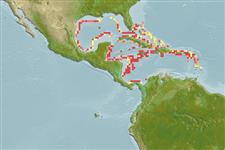
Western Central Pacific: Caribbean Sea.
Tamanho / Peso / Idade
Maturidade: Lm ? range ? - ? cm
Max length : 10.5 cm SL macho/indeterminado; (Ref. 13203)
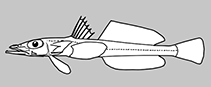
Espinhos dorsais (total) : 6; Raios dorsais moles (total) : 15 - 16; Raios anais moles: 17. Color in alcohol uniformly light yellowish brown. Snout relatively short, almost equal to eye diameter, with scales on lateral and dorsal surfaces including the area in front of eye. Upper jaw extending behind anterior margin of eye. Maxillary tentacle long, tapering at the end. Lateral line descending gradually in region of pectoral fin, separated from origin of first dorsal fin by 2-4 rows of scales, from origin of anal fin by 4-5, and from insertion of anal fin by 2. Spines of first dorsal fin not elongated (Ref 13203).
Body shape (shape guide): elongated.
Ciclo de vida e comportamento de acasalamento
Maturidade | Reprodução | Desova | Ovos | Fecundidade | Larvas
Das, M.K. and J.S. Nelson, 1996. Revision of the percophid genus Bembrops (Actinopterygii: Perciformes). Bull. Mar. Sci. 59(1):9-44. (Ref. 13203)
Categoria na Lista Vermelha da IUCN (Ref. 130435: Version 2025-2 (Global))
Ameaça para o homem
Harmless
Utilização humana
Ferramentas
Relatórios especiais
Descarregue XML
Fontes da internet
Estimativas baseadas em modelos
Temperatura preferida (Ref.
123201): 10.2 - 13.8, mean 12.2 °C (based on 8 cells).
Índice de diversidade filogenética (Ref.
82804): PD
50 = 0.5000 [Uniqueness, from 0.5 = low to 2.0 = high].
Bayesian length-weight: a=0.00380 (0.00158 - 0.00917), b=3.11 (2.90 - 3.32), in cm total length, based on LWR estimates for this (Sub)family-body shape (Ref.
93245).
Nível Trófico (Ref.
69278): 3.8 ±0.4 se; based on size and trophs of closest relatives
Vulnerabilidade da pesca (Ref.
59153): Low vulnerability (10 of 100).
🛈