>
Perciformes/Bembropoidei (Duckbill flatheads) >
Bembropidae (Duckbill flatheads)
Etymology: Bembrops: Greek, bembras, -ados = a kind of anchovy m+ Greek, ops = appearance (Ref. 45335); magnisquamis: Specific name from the Latin 'magnus' meaning large and 'squama' meaning scale.
More on author: Ginsburg.
Umwelt: Milieu / Klimazone / Tiefenbereich / Verbreitungsgebiet
Ökologie
seewasser bathydemersal; tiefenbereich 350 - 465 m (Ref. 13203). Deep-water
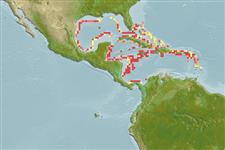
Western Central Pacific: Caribbean Sea.
Größe / Gewicht / Alter
Geschlechtsreife: Lm ? range ? - ? cm
Max length : 10.5 cm SL Männchen/unbestimmt; (Ref. 13203)
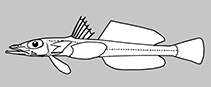
Rückenflossenstacheln (insgesamt) : 6; Rückenflossenweichstrahlen (insgesamt) : 15 - 16; Afterflossenweichstrahlen: 17. Color in alcohol uniformly light yellowish brown. Snout relatively short, almost equal to eye diameter, with scales on lateral and dorsal surfaces including the area in front of eye. Upper jaw extending behind anterior margin of eye. Maxillary tentacle long, tapering at the end. Lateral line descending gradually in region of pectoral fin, separated from origin of first dorsal fin by 2-4 rows of scales, from origin of anal fin by 4-5, and from insertion of anal fin by 2. Spines of first dorsal fin not elongated (Ref 13203).
Body shape (shape guide): elongated.
Lebenszyklus und Paarungsverhalten
Geschlechtsreife | Fortpflanzung | Ablaichen | Eier | Fruchtbarkeit | Larven
Das, M.K. and J.S. Nelson, 1996. Revision of the percophid genus Bembrops (Actinopterygii: Perciformes). Bull. Mar. Sci. 59(1):9-44. (Ref. 13203)
IUCN Rote Liste Status (Ref. 130435: Version 2025-2 (Global))
Bedrohung für Menschen
Harmless
Nutzung durch Menschen
Tools
Zusatzinformationen
Download XML
Internet Quellen
Schätzungen auf der Grundlage von Modellen
Bevorzugte Temperatur (Ref.
123201): 10.2 - 13.8, mean 12.2 °C (based on 8 cells).
Phylogenetischer Diversitätsindex (Ref.
82804): PD
50 = 0.5000 [Uniqueness, from 0.5 = low to 2.0 = high].
Bayesian length-weight: a=0.00380 (0.00158 - 0.00917), b=3.11 (2.90 - 3.32), in cm total length, based on LWR estimates for this (Sub)family-body shape (Ref.
93245).
Trophische Ebene (Ref.
69278): 3.8 ±0.4 se; based on size and trophs of closest relatives
Anfälligkeit der Fischerei (Ref.
59153): Low vulnerability (10 of 100).
🛈