>
Perciformes/Notothenioidei (Icefishes) >
Nototheniidae (Cod icefishes) > Nototheniinae
Etymology: Notothenia: Greek, 'notos', ou; νοτος, ου), from the south + Greek, 'e 'eutheneia',as or 'euthenia', as (ευθενεια, ας; ευθενια, ας), abundance (P. Romero, pers.comm. 01/16).
Eponymy: Rear-Admiral Sir James Clark Ross (1800–1862) discovered the Ross Sea and the Ross Ice Shelf and an island (1841) which Scott, on his first expedition, named Ross Island in his honour. [...] (Ref. 128868), visit book page.
More on author: Richardson.
Entorno: milieu / zona climática / rango de profundidad / gama de distribución
Ecología
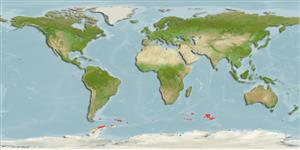
marino demersal; oceanodromo (Ref. 51243); rango de profundidad 5 - 350 m (Ref. 28106), usually 5 - 350 m (Ref. 28106). Polar; -1°C - 5°C (Ref. 28106); 45°S - 67°S, 75°W - 165°E
Southern Ocean: northern end of the Antarctic Peninsula, Scotia Arc, Prince Edward, Crozet, Kerguelen, Heard and Macquarie islands, and Ob' and Lena banks.
Longitud en la primera madurez / Tamaño / Peso / Edad
Madurez: Lm 49.3 range ? - ? cm
Max length : 92.0 cm TL macho / no sexado; (Ref. 5179); common length : 50.0 cm TL macho / no sexado; (Ref. 2121); peso máximo publicado: 10.0 kg (Ref. 5179); edad máxima reportada: 16 años (Ref. 28106)
Espinas dorsales (total) : 4 - 7; Radios blandos dorsales (total) : 32 - 36; Radios blandos anales: 26 - 30.
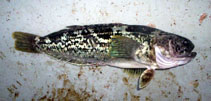
Body shape (shape guide): fusiform / normal.
The sexually immature members of the population stay in lesser depths, mainly in the shallow fjord bays. Yearlings feed mainly on mesozooplankton in the near surface zone (5-15 m). Immature and mature fish are benthic but stay in shallower depths (10-20 m). Sexually mature fish move out of the fjord to stay in the shelf zone. Spawn once a year (Ref. 89316). Maximum life span for males is 12 years (Ref. 28106).
Mature females may spawn for the first time from around 6-8 years of age (Ref. 71843).
Hureau, J.-C., 1985. Family Notothenidae - Antarctic rock cods. p. 323-385. In W. Fischer and J.C. Hureau (eds.) FAO species identification sheets for fishery purposes. Southern Ocean (Fishing areas 48, 58 and 88) (CCAMLR Convention Area). Rome, FAO. Vol. 2. (Ref. 2121)
Situación en la Lista Roja de la UICN (Ref. 130435: Version 2025-2 (Global))
Amenaza para el ser humano
Harmless
Usos humanos
Pesquerías: comercial
Herramientas
Informes especiales
Descargar XML
Fuentes de Internet
Estimaciones basadas en modelos
Temperatura preferida (Referencia
123201): 0.7 - 4.7, mean 2.1 °C (based on 140 cells).
Índice de diversidad filogenética (Referencia
82804): PD
50 = 0.5312 [Uniqueness, from 0.5 = low to 2.0 = high].
Bayesian length-weight: a=0.00589 (0.00479 - 0.00724), b=3.19 (3.13 - 3.25), in cm total length, based on LWR estimates for this species (Ref.
93245).
Nivel trófico (Referencia
69278): 3.6 ±0.56 se; based on food items.
Generation time: 8.5 (6.1 - 9.8) years. Estimated as median ln(3)/K based on 17
growth studies.
Resiliencia (Referencia
120179): Bajo, población duplicada en un tiempo mínimo de 4.5-14 años (K=0.10-0.16; tmax=16; Fec=19,000).
Vulnerabilidad pesquera (Ref.
59153): High vulnerability (63 of 100).
🛈
Vulnerabilidad climática (Ref.
125649): Moderate to high vulnerability (54 of 100).
🛈
Nutrientes (Ref.
124155): Calcium = 16.7 [10.3, 37.7] mg/100g; Iron = 0.427 [0.187, 0.808] mg/100g; Protein = 18.2 [15.8, 20.4] %; Omega3 = 0.316 [0.187, 0.528] g/100g; Selenium = 18.1 [8.2, 38.9] μg/100g; VitaminA = 12.2 [2.9, 56.1] μg/100g; Zinc = 0.35 [0.24, 0.52] mg/100g (wet weight);