>
Perciformes/Notothenioidei (Icefishes) >
Nototheniidae (Cod icefishes) > Nototheniinae
Etymology: Notothenia: Greek, 'notos', ou; νοτος, ου), from the south + Greek, 'e 'eutheneia',as or 'euthenia', as (ευθενεια, ας; ευθενια, ας), abundance (P. Romero, pers.comm. 01/16).
Eponymy: Rear-Admiral Sir James Clark Ross (1800–1862) discovered the Ross Sea and the Ross Ice Shelf and an island (1841) which Scott, on his first expedition, named Ross Island in his honour. [...] (Ref. 128868), visit book page.
More on author: Richardson.
Ambiente: milieu / zona climatica / distribuzione batimetrica / gamma di distribuzione
Ecologia
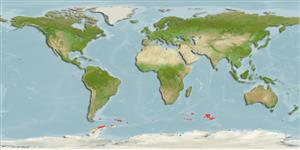
marino demersale; oceanodromo (Ref. 51243); distribuzione batimetrica 5 - 350 m (Ref. 28106), usually 5 - 350 m (Ref. 28106). Polar; -1°C - 5°C (Ref. 28106); 45°S - 67°S, 75°W - 165°E
Southern Ocean: northern end of the Antarctic Peninsula, Scotia Arc, Prince Edward, Crozet, Kerguelen, Heard and Macquarie islands, and Ob' and Lena banks.
Lunghezza alla prima maturità / Dimensione / Peso / Età
Maturità: Lm 49.3 range ? - ? cm
Max length : 92.0 cm TL maschio/sesso non determinato; (Ref. 5179); common length : 50.0 cm TL maschio/sesso non determinato; (Ref. 2121); peso massimo pubblicato: 10.0 kg (Ref. 5179); Età massima riportata: 16 anni (Ref. 28106)
Spine dorsali (totale) : 4 - 7; Raggi dorsali molli (totale) : 32 - 36; Raggi anali molli: 26 - 30.
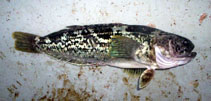
Body shape (shape guide): fusiform / normal.
The sexually immature members of the population stay in lesser depths, mainly in the shallow fjord bays. Yearlings feed mainly on mesozooplankton in the near surface zone (5-15 m). Immature and mature fish are benthic but stay in shallower depths (10-20 m). Sexually mature fish move out of the fjord to stay in the shelf zone. Spawn once a year (Ref. 89316). Maximum life span for males is 12 years (Ref. 28106).
Mature females may spawn for the first time from around 6-8 years of age (Ref. 71843).
Hureau, J.-C., 1985. Family Notothenidae - Antarctic rock cods. p. 323-385. In W. Fischer and J.C. Hureau (eds.) FAO species identification sheets for fishery purposes. Southern Ocean (Fishing areas 48, 58 and 88) (CCAMLR Convention Area). Rome, FAO. Vol. 2. (Ref. 2121)
Stato della Lista Rossa IUCN (Ref. 130435: Version 2025-2 (Global))
Minaccia per l'uomo
Harmless
Usi umani
Pesca: commerciale
Strumenti
Rapporti speciali
Scarica XML
Fonti Internet
Stime basate su modelli
Temperatura preferita (Fonte Biblio.
123201): 0.7 - 4.7, mean 2.1 °C (based on 140 cells).
Indice di diversità filogenetica (Fonte Biblio.
82804): PD
50 = 0.5312 [Uniqueness, from 0.5 = low to 2.0 = high].
Bayesian length-weight: a=0.00589 (0.00479 - 0.00724), b=3.19 (3.13 - 3.25), in cm total length, based on LWR estimates for this species (Ref.
93245).
Livello trofico (Fonte Biblio.
69278): 3.6 ±0.56 se; based on food items.
Generation time: 8.5 (6.1 - 9.8) years. Estimated as median ln(3)/K based on 17
growth studies.
Resilienza (Fonte Biblio.
120179): Basso, tempo minimo di raddoppiamento della popolazione 4.5 - 14 anni (K=0.10-0.16; tmax=16; Fec=19,000).
Vulnerabilità della pesca (Ref.
59153): High vulnerability (63 of 100).
🛈
Vulnerabilità climatica (Ref.
125649): Moderate to high vulnerability (54 of 100).
🛈
Nutrienti (Ref.
124155): Calcium = 16.7 [10.3, 37.7] mg/100g; Iron = 0.427 [0.187, 0.808] mg/100g; Protein = 18.2 [15.8, 20.4] %; Omega3 = 0.316 [0.187, 0.528] g/100g; Selenium = 18.1 [8.2, 38.9] μg/100g; VitaminA = 12.2 [2.9, 56.1] μg/100g; Zinc = 0.35 [0.24, 0.52] mg/100g (wet weight);