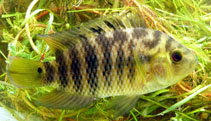
>
Cichliformes (Cichlids, convict blennies) >
Cichlidae (Cichlids) > Cichlinae
Etymology: Australoheros: From the Latin word 'australis' meaning southern, and the name Heros, after the nominotypic genus of the Heroini tribe.
Tribe.
More on author: Jenyns.
Entorno: milieu / zona climática / rango de profundidad / gama de distribución
Ecología
; agua dulce bentopelágico; pH range: 6.5 - 7.0; dH range: 5 - 12. Subtropical; 25°C - 30°C (Ref. 1672)
South America: Coastal drainages of Uruguay and Rio Grande do Sul, Brazil; Paraná River basin, lower part of Paraná River in Argentina.
Tamaño / Peso / Edad
Madurez: Lm ? range ? - ? cm
Max length : 19.3 cm SL macho / no sexado; (Ref. 56003); common length : 18.0 cm TL macho / no sexado; (Ref. 36377); edad máxima reportada: 10 años (Ref. 40602)
Descripción breve
Claves de identificación | Morfología | Morfometría
Espinas dorsales (total) : 15 - 17; Radios blandos dorsales (total) : 9 - 11; Espinas anales: 5 - 7; Radios blandos anales: 7 - 9. This species differs from its congeners in having a lower jaw longer than upper and mouth pointing upwards; has the shortest dorsal scale cover and the least scaled dorsal and anal fins among (together with A. tembe); with four abdominal bars (present in more than 80% of individuals as compared to 50% or less in all other species (Ref. 74689).
Body shape (shape guide): short and / or deep.
An opportunistic diurnal feeder, eating detritus and plant material, preying on small aquatic animals, including small fish. Very resistant to low temperatures. (Ref. 59043). Common in creeks, rivers, swamps and lakes (Ref. 74689). This species is an easy open spawner that lays its eggs on a stone or piece of wood (Ref. 12251). Both parents care for the eggs and fry (Ref. 12251). Consumed locally. Reported to reach 25.0 cm SL (Ref. 59043).
This species is an easy open spawner that lays its eggs on a stone or piece of wood. Both parents care for the eggs and fry (Ref. 12251). In Europe where it has invaded native drainages, spawns when temperature rises above 28-30°C. Forms pairs during spawning and both sexes are territorial. Females deposits eggs on exposed hard surfaces such as stones or wood. Both parent guard larvae and juveniles for 1-3 weeks (Ref. 59043).
Říčan, O. and S.O. Kullander, 2008. The Australoheros (Teleostei: Cichlidae) species of Uruguay and Paraná River drainages. Zootaxa 1724:1-51. (Ref. 74689)
Situación en la Lista Roja de la UICN (Ref. 130435: Version 2025-2 (Global))
Amenaza para el ser humano
Harmless
Usos humanos
Pesquerías: sin interés; Acuario: Comercial
Herramientas
Informes especiales
Descargar XML
Fuentes de Internet
Estimaciones basadas en modelos
Índice de diversidad filogenética (Referencia
82804): PD
50 = 0.5000 [Uniqueness, from 0.5 = low to 2.0 = high].
Bayesian length-weight: a=0.02512 (0.01600 - 0.03945), b=3.04 (2.91 - 3.17), in cm total length, based on LWR estimates for this species & (Sub)family-body (Ref.
93245).
Nivel trófico (Referencia
69278): 3.3 ±0.48 se; based on food items.
Resiliencia (Referencia
120179): Medio, población duplicada en un tiempo mínimo de 1.4-4.4 años (tmax=10; Fec=300-1,000).
Vulnerabilidad pesquera (Ref.
59153): Low vulnerability (14 of 100).
🛈