>
Cichliformes (Cichlids, convict blennies) >
Cichlidae (Cichlids) > Cichlinae
Etymology: Australoheros: From the Latin word 'australis' meaning southern, and the name Heros, after the nominotypic genus of the Heroini tribe.
Tribe.
More on author: Jenyns.
Lingkungan: lingkungan / zona iklim / kisaran kedalaman / jangkauan distribusi
Ekologi
; air tawar bentopelagis; pH range: 6.5 - 7.0; dH range: 5 - 12. Subtropical; 25°C - 30°C (Ref. 1672)
South America: Coastal drainages of Uruguay and Rio Grande do Sul, Brazil; Paraná River basin, lower part of Paraná River in Argentina.
Ukuran / Berat / umur
Kematangan: Lm ? range ? - ? cm
Max length : 19.3 cm SL jantan/; (Ref. 56003); common length : 18.0 cm TL jantan/; (Ref. 36377); Umur maksimum dilaporkan: 10 Tahun (Ref. 40602)
deskripsi pendek
Kunci identifiaksi (pengenalan) | Morfologi | Morfometrik
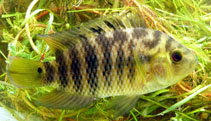
Duri punggung (Keseluruhan (total)) : 15 - 17; duri punggung lunak (Keseluruhan (total)) : 9 - 11; Duri dubur: 5 - 7; Sirip dubur lunak: 7 - 9. This species differs from its congeners in having a lower jaw longer than upper and mouth pointing upwards; has the shortest dorsal scale cover and the least scaled dorsal and anal fins among (together with A. tembe); with four abdominal bars (present in more than 80% of individuals as compared to 50% or less in all other species (Ref. 74689).
Body shape (shape guide): short and / or deep.
An opportunistic diurnal feeder, eating detritus and plant material, preying on small aquatic animals, including small fish. Very resistant to low temperatures. (Ref. 59043). Common in creeks, rivers, swamps and lakes (Ref. 74689). This species is an easy open spawner that lays its eggs on a stone or piece of wood (Ref. 12251). Both parents care for the eggs and fry (Ref. 12251). Consumed locally. Reported to reach 25.0 cm SL (Ref. 59043).
This species is an easy open spawner that lays its eggs on a stone or piece of wood. Both parents care for the eggs and fry (Ref. 12251). In Europe where it has invaded native drainages, spawns when temperature rises above 28-30°C. Forms pairs during spawning and both sexes are territorial. Females deposits eggs on exposed hard surfaces such as stones or wood. Both parent guard larvae and juveniles for 1-3 weeks (Ref. 59043).
Říčan, O. and S.O. Kullander, 2008. The Australoheros (Teleostei: Cichlidae) species of Uruguay and Paraná River drainages. Zootaxa 1724:1-51. (Ref. 74689)
Status IUCN Red List (Ref. 130435: Version 2025-2 (Global))
ancaman kepada manusia
Harmless
penggunaan manusia
Perikanan: tidak ada kepentingan; Akuarium: Komersial
Alat, peralatan
laporan khas
muat turun XML
Sumber internet
Estimasi berdasarkan model
Indeks keanekaragaman filogenetik (Acuan
82804): PD
50 = 0.5000 [Uniqueness, from 0.5 = low to 2.0 = high].
Bayesian length-weight: a=0.02512 (0.01600 - 0.03945), b=3.04 (2.91 - 3.17), in cm total length, based on LWR estimates for this species & (Sub)family-body (Ref.
93245).
Tingkat Trofik (Acuan
69278): 3.3 ±0.48 se; based on food items.
Daya lenting (Acuan
120179): sedang, Waktu penggandaan populasi minimum 1.4 - 4.4 tahun (tmax=10; Fec=300-1,000).
Kerentanan Penangkapan Ikan (Ref.
59153): Low vulnerability (14 of 100).
🛈