>
Mulliformes (Goatfishes) >
Mullidae (Goatfishes)
Etymology: Upeneus: Greek, ypene, -es = upper lip (Ref. 45335).
Eponymy: Dr Francis Dov Por né Francisc Bernard Pór (1927–2014) was a Romanian hydrobiologist and biogeographer. [...] (Ref. 128868), visit book page.
Milieu: milieu / Klimaatzone / Diepte / verspreidingsgebied
Ecologie
marien demersaal; diepte 20 - 52 m (Ref. 123119). Subtropical
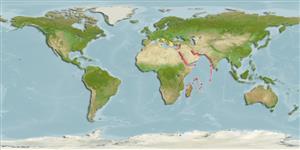
Western Indian Ocean: Red Sea to Oman, Madagascar, South Africa, Eastern Mediterranean (via Suez Canal).
Lengte bij maturiteit / Grootte / Gewicht / Leeftijd
Maturiteit: Lm 10.6, range 10 - 10.9 cm
Max length : 19.0 cm TL mannelijk / geslacht onbekend; (Ref. 11441); max. gepubliceerd gewicht: 70.00 g (Ref. 124816)
Korte beschrijving
Determinatiesleutels | Morfologie | Morfometrie
Dorsale stekels (totaal) : 7; Dorsale zachte stralen (totaal) : 9. This species is distinguished by the following characters: D VII,9; pectoral fins 13-15; gill rakers 7-8 + 18-21 = 25-29. Measurements as % SL: body depth at first dorsal fin origin 21-24, at anus 18-22; caudal-peduncle depth 8.8-10; maximum head depth 18-21; head depth through eye 14-16; head length 26-380; snout length 9.5-12; orbit length 5.8-7.8; upper jaw length 9.9-12; barbel length 16-19; caudal-fin length 27-29; anal-fin height 14-17; pelvic-fin length 19-23; pectoral-fin length 18-22; first dorsal-fin height 18-22 with dorsal spines proportionally decreasing in height; second dorsal-fin height 13-17. Caudal fin of adults with 11-16 total bars, upper caudal-fin lobe with 5-6 reddish or red-brown bars, with 4-5 (rarely 3) bars distally from fork, and 1 bar close to lobe base, mostly narrower than the pale interspaces between bars; the ventral half side of lower lobe with 5-9 red, red-brown or grey bars, extending to a broad red, brown or dark-grey stripe along middle of lobe; inner, dorsal third of
lower caudal-fin lobe with 3-4 red, red-brown or grey bars; when preserved the caudal-fin bar pigmentation often retained; fresh fish sometimes with a faint
or (in life) conspicuous red or red-brown mid-lateral stripe from snout through eye to caudal-fin base, not retained in preservative. Colouration: barbels are white or creamy white in fresh fish; head and body colour white, pale grey or pale yellow ventrally and red brown or grey dorsally; the belly is white; when preserved the is body pale brown ventrally and often dorsally darkened (Ref. 123119).
Cross section: compressed.
Occurs in shallow littoral zone to 52 m depth (Ref. 123119); shallow dpeth from Khalaf et al., 1997 (Ref. 48643). Feeds on hypobenthic invertebrates, mainly crustaceans and, to a lesser extent, polychaetes, which they detect with their barbels (Ref. 43448).
Randall, J.E., 1995. Coastal fishes of Oman. University of Hawaii Press, Honolulu, Hawaii. 439 p. (Ref. 11441)
Status op de Rode Lijst van het IUCN (Ref. 130435: Version 2025-2 (Global))
Gevaar voor de mens
Harmless
Gebruik door de mens
Tools
Speciale rapporten
Download XML
Internetbronnen
Schattingen op basis van modellen
Gewenste temperatuur (Ref.
123201): 19.3 - 27.6, mean 25.6 °C (based on 548 cells).
Fylogenetische diversiteitsindex (Ref.
82804): PD
50 = 0.5000 [Uniqueness, from 0.5 = low to 2.0 = high].
Bayesian length-weight: a=0.00851 (0.00704 - 0.01029), b=3.09 (3.06 - 3.12), in cm total length, based on LWR estimates for this species (Ref.
93245).
Trofisch niveau (Ref.
69278): 3.5 ±0.5 se; based on diet studies.
Weerstandsvermogen (Ref.
120179): Gemiddeld, minimale populatieverdubbelingstijd 1,4-4,4 jaar (K=0.16-0.4 ;).
Kwetsbaarheid van de visserij (Ref.
59153): Low vulnerability (10 of 100).
🛈
Voedingsstoffen (Ref.
124155): Calcium = 118 [62, 269] mg/100g; Iron = 0.989 [0.472, 1.838] mg/100g; Protein = 17.7 [15.7, 20.0] %; Omega3 = 0.408 [0.250, 0.733] g/100g; Selenium = 17.9 [9.4, 36.6] μg/100g; VitaminA = 27.5 [8.4, 106.9] μg/100g; Zinc = 0.96 [0.57, 1.39] mg/100g (wet weight);