>
Gobiesociformes (Clingfishes) >
Gobiesocidae (Clingfishes and singleslits) > Haplocylicinae
Etymology: Haplocylix: Greek, haploos = single + Greek, kylix, -ikos = glass, cup (Ref. 45335).
More on author: Forster.
Environnement : milieu / zone climatique / profondeur / gamme de distribution
Écologie
marin démersal; profondeur 0 - 12 m (Ref. 9003). Temperate
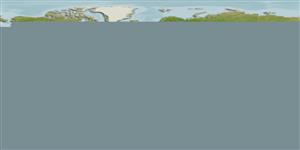
Southwest Pacific: endemic to New Zealand.
Taille / Poids / Âge
Maturité: Lm ? range ? - ? cm
Max length : 15.0 cm TL mâle / non sexé; (Ref. 9003); âge max. reporté: 6 années (Ref. 9003)
Description synthétique
Clés d'identification | Morphologie | Morphométrie
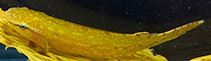
Épines dorsales (Total) : 0; Rayons mous dorsaux (Total) : 5 - 6; Épines anales: 0; Rayons mous anaux: 8 - 9. Color ranging from uniform olive green to golden brown or yellowish, sometimes lighter ventrally. Sometimes with darker streaks over the head and body or patches of white or pink. Distinguished from other clingfishes by its large size, broad spade-like body, and structure of sucking disc (absence of a fold of skin on the anterior margin of the rear portion).
Body shape (shape guide): elongated.
Common in rock pools, larger individuals found in subtidal area. Usually attached to seaweeds (Cystophora, Macrocystis and Lessonia), sometimes on rocks and boulder in areas with dense seaweed. Remains motionless when the pool is disturbed.
Cycle de vie et comportement reproducteur
Maturité | Reproduction | Frai | Œufs | Fécondité | Larves
Paulin, C. and C. Roberts, 1992. The rockpool fishes of New Zealand (Te ika aaria o Aotearoa). Museum of New Zealand (Te Papa Tongarewa). 177 p. (Ref. 9003)
Statut dans la liste rouge de l'IUCN (Ref. 130435: Version 2025-2 (Global))
Menace pour l'homme
Harmless
Utilisations par l'homme
Outils
Articles particuliers
Télécharger en XML
Sources Internet
Estimations basées sur des modèles
Température préférée (Réf.
123201): 13.8 - 18.3, mean 16.4 °C (based on 100 cells).
Indice de diversité phylogénétique (Réf.
82804): PD
50 = 1.0000 [Uniqueness, from 0.5 = low to 2.0 = high].
Bayesian length-weight: a=0.00427 (0.00205 - 0.00886), b=3.14 (2.94 - 3.34), in cm total length, based on LWR estimates for this species & (Sub)family-body (Ref.
93245).
Niveau trophique (Réf.
69278): 3.4 ±0.3 se; based on size and trophs of closest relatives
Résilience (Réf.
120179): Faible, temps minimum de doublement de population : 4,5 à 14 années (Fec = 50).
Vulnérabilité de la pêche (Ref.
59153): Low vulnerability (10 of 100).
🛈
Nutriments (Ref.
124155): Calcium = 76.1 [42.5, 172.8] mg/100g; Iron = 0.398 [0.227, 0.755] mg/100g; Protein = 17.1 [15.9, 18.3] %; Omega3 = 0.412 [0.204, 0.836] g/100g; Selenium = 7 [3, 17] μg/100g; VitaminA = 34.8 [8.6, 140.7] μg/100g; Zinc = 0.922 [0.611, 1.358] mg/100g (wet weight);