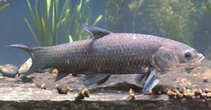
Entorno: milieu / zona climática / rango de profundidad / gama de distribución
Ecología
; agua dulce; salobre demersal; pH range: 7.5 - 8.5; potamodromo (Ref. 126106); rango de profundidad 5 - 30 m (Ref. 6898). Subtropical; 0°C - 40°C (Ref. 55930); 53°N - 15°N, 100°E - 140°E (Ref. 55930)
Asia: Amur river basin to southern China (Ref. 55930). Reported from Vietnam (Ref. 44416). Persists only in Europe by stocking or accidental releases; native stocks in Russia have declined sharply (Ref. 59043). Several countries reported adverse ecological impact after introduction.
Longitud en la primera madurez / Tamaño / Peso / Edad
Madurez: Lm 91.5, range 100 - ? cm
Max length : 180 cm TL macho / no sexado; (Ref. 40637); common length : 12.2 cm SL macho / no sexado; (Ref. 35840); peso máximo publicado: 35.0 kg (Ref. 56557); edad máxima reportada: 13 años (Ref. 55930)
Descripción breve
Claves de identificación | Morfología | Morfometría
Espinas dorsales (total) : 0; Radios blandos dorsales (total) : 7 - 9; Espinas anales: 0; Radios blandos anales: 8 - 10. Anatomy of the pharyngeal apparatus is the main distinguishing characteristic; throat teeth typically form a single row of 4-5 large molariform teeth on each of the two arches, with formula typically 1,4 - 4,1.
Body shape (shape guide): fusiform / normal; Cross section: circular.
Adults inhabit large lowland rivers and lakes, preferably with clear water and high oxygen concentrations. Larvae feed on zooplankton, then on ostracods and aquatic insects. At about 120 mm SL, juveniles start to prey on small snails and clams while larger juveniles and adults feed almost entirely on molluscs. Undertake upriver migration and spawns in open waters. Deposit pelagic or semipelagic eggs which hatch while drifting downstream. Larvae settle into floodplain lakes and channels with little or no current (Ref. 59043). Maximum age probably exceeds 15 years; the figure of 20 years is not supported by data (Ref. 55930).
Prewspawning adults migrate upstream in spring - early summer; spawning takes place in turbulent waters; eggs are pelagic and drift downstream and larvae enter nursery areas such as flood plains or backwater habitats; main river channel is used as feeding and wintering area by subadults and adults.
Nico, L.G., J.D. Williams and H.L. Jelks, 2005. Black carp: biological synopsis and risk assessment of an introduced fish. American Fisheries Society, Bethesda, Maryland, USA. 337 p. (Ref. 55930)
Situación en la Lista Roja de la UICN (Ref. 130435: Version 2025-2 (Global))
Amenaza para el ser humano
Potential pest (Ref. 74657)
Usos humanos
Pesquerías: muy comercial; Acuicultura: comercial
Herramientas
Informes especiales
Descargar XML
Fuentes de Internet
Estimaciones basadas en modelos
Índice de diversidad filogenética (Referencia
82804): PD
50 = 1.0000 [Uniqueness, from 0.5 = low to 2.0 = high].
Bayesian length-weight: a=0.00891 (0.00760 - 0.01045), b=3.09 (3.05 - 3.13), in cm total length, based on LWR estimates for this species (Ref.
93245).
Nivel trófico (Referencia
69278): 3.2 ±0.44 se; based on food items.
Resiliencia (Referencia
120179): Bajo, población duplicada en un tiempo mínimo de 4.5-14 años (K=0.08-0.09; tm=3-9; tmax >13; Fec=1,000,000).
Vulnerabilidad pesquera (Ref.
59153): Very high vulnerability (80 of 100).
🛈
Nutrientes (Ref.
124155): Calcium = 73 [39, 113] mg/100g; Iron = 1.13 [0.72, 1.80] mg/100g; Protein = 18.9 [18.0, 19.8] %; Omega3 = 0.335 [0.177, 0.670] g/100g; Selenium = 31.1 [15.8, 64.3] μg/100g; VitaminA = 7.37 [2.88, 20.58] μg/100g; Zinc = 0.713 [0.531, 0.987] mg/100g (wet weight);