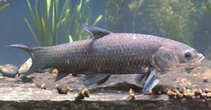
Ambiente: milieu / zona climatica / distribuzione batimetrica / gamma di distribuzione
Ecologia
; acqua dolce; salmastro demersale; pH range: 7.5 - 8.5; potamodromo (Ref. 126106); distribuzione batimetrica 5 - 30 m (Ref. 6898). Subtropical; 0°C - 40°C (Ref. 55930); 53°N - 15°N, 100°E - 140°E (Ref. 55930)
Asia: Amur river basin to southern China (Ref. 55930). Reported from Vietnam (Ref. 44416). Persists only in Europe by stocking or accidental releases; native stocks in Russia have declined sharply (Ref. 59043). Several countries reported adverse ecological impact after introduction.
Lunghezza alla prima maturità / Dimensione / Peso / Età
Maturità: Lm 91.5, range 100 - ? cm
Max length : 180 cm TL maschio/sesso non determinato; (Ref. 40637); common length : 12.2 cm SL maschio/sesso non determinato; (Ref. 35840); peso massimo pubblicato: 35.0 kg (Ref. 56557); Età massima riportata: 13 anni (Ref. 55930)
Breve descrizione
Chiavi di identificazione | Morfologia | Morfometria
Spine dorsali (totale) : 0; Raggi dorsali molli (totale) : 7 - 9; Spine anali: 0; Raggi anali molli: 8 - 10. Anatomy of the pharyngeal apparatus is the main distinguishing characteristic; throat teeth typically form a single row of 4-5 large molariform teeth on each of the two arches, with formula typically 1,4 - 4,1.
Body shape (shape guide): fusiform / normal; Cross section: circular.
Adults inhabit large lowland rivers and lakes, preferably with clear water and high oxygen concentrations. Larvae feed on zooplankton, then on ostracods and aquatic insects. At about 120 mm SL, juveniles start to prey on small snails and clams while larger juveniles and adults feed almost entirely on molluscs. Undertake upriver migration and spawns in open waters. Deposit pelagic or semipelagic eggs which hatch while drifting downstream. Larvae settle into floodplain lakes and channels with little or no current (Ref. 59043). Maximum age probably exceeds 15 years; the figure of 20 years is not supported by data (Ref. 55930).
Prewspawning adults migrate upstream in spring - early summer; spawning takes place in turbulent waters; eggs are pelagic and drift downstream and larvae enter nursery areas such as flood plains or backwater habitats; main river channel is used as feeding and wintering area by subadults and adults.
Nico, L.G., J.D. Williams and H.L. Jelks, 2005. Black carp: biological synopsis and risk assessment of an introduced fish. American Fisheries Society, Bethesda, Maryland, USA. 337 p. (Ref. 55930)
Stato della Lista Rossa IUCN (Ref. 130435: Version 2025-2 (Global))
Minaccia per l'uomo
Potential pest (Ref. 74657)
Usi umani
Pesca: elevato interesse commerciale; Acquacoltura: commerciale
Strumenti
Rapporti speciali
Scarica XML
Fonti Internet
Stime basate su modelli
Indice di diversità filogenetica (Fonte Biblio.
82804): PD
50 = 1.0000 [Uniqueness, from 0.5 = low to 2.0 = high].
Bayesian length-weight: a=0.00891 (0.00760 - 0.01045), b=3.09 (3.05 - 3.13), in cm total length, based on LWR estimates for this species (Ref.
93245).
Livello trofico (Fonte Biblio.
69278): 3.2 ±0.44 se; based on food items.
Resilienza (Fonte Biblio.
120179): Basso, tempo minimo di raddoppiamento della popolazione 4.5 - 14 anni (K=0.08-0.09; tm=3-9; tmax >13; Fec=1,000,000).
Vulnerabilità della pesca (Ref.
59153): Very high vulnerability (80 of 100).
🛈
Nutrienti (Ref.
124155): Calcium = 73 [39, 113] mg/100g; Iron = 1.13 [0.72, 1.80] mg/100g; Protein = 18.9 [18.0, 19.8] %; Omega3 = 0.335 [0.177, 0.670] g/100g; Selenium = 31.1 [15.8, 64.3] μg/100g; VitaminA = 7.37 [2.88, 20.58] μg/100g; Zinc = 0.713 [0.531, 0.987] mg/100g (wet weight);