>
Acropomatiformes (Oceanic basses) >
Lateolabracidae (Asian seaperches)
Etymology: Lateolabrax: Greek, latos, a fish of the Nile + Greek, labrax, -akos = a fish (Dicentrarchus labrax) (Ref. 45335).
More on author: Cuvier.
Taxonomic Remarks
Junior synonym Lateolabrax maculatus considered as a valid species reported to be widely distributed (Japan, only in the Ariake Sea and off Nagasaki; China (off all coasts), Taiwan, and Korea (usually off the southern and western coasts) (Ref. 118669)
Umwelt: Milieu / Klimazone / Tiefenbereich / Verbreitungsgebiet
Ökologie
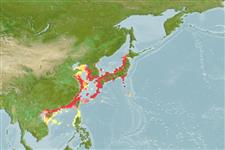
seewasser; süßwasser; brackwasser riff-verbunden; katadrom (Ref. 36558); tiefenbereich 5 - ? m. Subtropical; 44°N - 15°N, 106°E - 143°E
Western Pacific: Japan to the South China Sea.
Länge bei der ersten Reifung / Größe / Gewicht / Alter
Geschlechtsreife: Lm ?, range 50 - ? cm
Max length : 102 cm TL Männchen/unbestimmt; (Ref. 40637); common length : 16.1 cm SL Männchen/unbestimmt; (Ref. 35840); max. veröff. Gewicht: 8.7 kg (Ref. 40637)
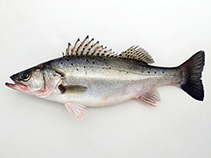
Rückenflossenstacheln (insgesamt) : 12 - 15; Rückenflossenweichstrahlen (insgesamt) : 12 - 14; Afterflossenstacheln: 3; Afterflossenweichstrahlen: 7 - 9.
Body shape (shape guide): fusiform / normal.
Found in moving water of inshore rocky reefs. Juveniles may ascend rivers and return to sea to spawn. Protandrous, sex change happens after maturation at age 2 (Ref. 36558). Spawning occurs during winter, in deeper rocky reefs or inshore areas. Predaceous, feeding on zooplankton at an early age and on small fish and shrimps as adults (Ref. 12497). Utilized as a food fish (Ref. 559). Family placement uncertain (Ref. 1830). Used in Chinese medicine (Ref. 12166).
Males mature at age 2 years, becoming females when older (Ref. 36558). Juveniles may ascend rivers migrating to the sea to spawn (Ref. 36558).
Paxton, J.R., D.F. Hoese, G.R. Allen and J.E. Hanley, 1989. Pisces. Petromyzontidae to Carangidae. Zoological Catalogue of Australia, Vol. 7. Australian Government Publishing Service, Canberra, 665 p. (Ref. 7300)
IUCN Rote Liste Status (Ref. 130435: Version 2025-2 (Global))
Bedrohung für Menschen
Harmless
Nutzung durch Menschen
Fischereien: kommerziell; Aquakultur: kommerziell; Sportfisch: ja
Tools
Zusatzinformationen
Download XML
Internet Quellen
Schätzungen auf der Grundlage von Modellen
Bevorzugte Temperatur (Ref.
123201): 12.7 - 26.3, mean 22.4 °C (based on 180 cells).
Phylogenetischer Diversitätsindex (Ref.
82804): PD
50 = 1.0000 [Uniqueness, from 0.5 = low to 2.0 = high].
Bayesian length-weight: a=0.01259 (0.00883 - 0.01795), b=3.02 (2.92 - 3.12), in cm total length, based on LWR estimates for this species (Ref.
93245).
Trophische Ebene (Ref.
69278): 3.1 ±0.3 se; based on diet studies.
Widerstandsfähigkeit (Ref.
120179): mittel, Verdopplung der Population dauert 1,4 - 4,4 Jahre. (K=0.14-0.2; tm=2; Fec=1,726,242).
Anfälligkeit der Fischerei (Ref.
59153): Moderate to high vulnerability (52 of 100).
🛈
Klimaanfälligkeit (Ref.
125649): Moderate to high vulnerability (54 of 100).
🛈
Nährstoffe (Ref.
124155): Calcium = 16.5 [8.1, 32.0] mg/100g; Iron = 0.471 [0.277, 0.738] mg/100g; Protein = 20.1 [19.0, 21.0] %; Omega3 = 0.212 [0.131, 0.340] g/100g; Selenium = 24.4 [12.4, 44.2] μg/100g; VitaminA = 24.7 [8.1, 76.3] μg/100g; Zinc = 0.756 [0.525, 1.096] mg/100g (wet weight); based on
nutrient studies.