>
Eupercaria/misc (Various families in series Eupercaria) >
Labridae (Wrasses) > Labrinae
Etymology: Tautoga: Plural of the word "taut", an Indian Brazil name translated by Roger William from f the Narragansett, "tautauog" = sheepshead.
More on author: Linnaeus.
Ambiente: milieu / zona climatica / distribuzione batimetrica / gamma di distribuzione
Ecologia
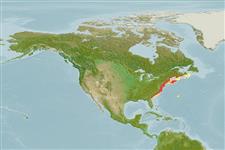
marino; salmastro associati a barriera corallina; distribuzione batimetrica 1 - 75 m. Subtropical; 46°N - 31°N, 81°W - 58°W
Western Atlantic: slightly east of Halifax in Nova Scotia, Canada to South Carolina in USA; most abundant between Cape Cod and Delaware Bay.
Lunghezza alla prima maturità / Dimensione / Peso / Età
Maturità: Lm 23.6, range 18 - 26.5 cm
Max length : 91.0 cm TL maschio/sesso non determinato; (Ref. 7251); peso massimo pubblicato: 11.3 kg (Ref. 40637); Età massima riportata: 34 anni (Ref. 6486)
Breve descrizione
Chiavi di identificazione | Morfologia | Morfometria
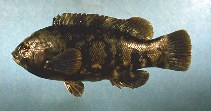
Spine dorsali (totale) : 16 - 17; Raggi dorsali molli (totale) : 10; Spine anali: 3; Raggi anali molli: 7 - 8. Distinguished from Tautogolabrus adspersus which occurs in the same area and further north, by its steep, rounded dorsal head profile; stouter body; scaled lower gill cover; and the more backward location of the pelvic fins.
Body shape (shape guide): fusiform / normal; Cross section: compressed.
Found close to shore on hard-bottom habitats, occasionally entering brackish water. Adult male territorial and active during the day to feed and rests in crevices at night. Prefers temperatures above 10°C. Spawning was noted in June-July in Canadian waters, but appears more protracted (April-July) in coastal waters of Virginia, USA. Feeds mainly on mussels, gastropods, other mollusks and crustaceans. This species has gained popularity as a prized food and sport fish (Ref. 6486, 4926, 41297). Investigation on the diel and seasonal activity patterns of the adult tautog in its southern range were conducted using ultrasonic telemetry (Ref. 41297).
Spawns in groups or in pairs. Pairing occurs between females and size-dominant males exhibiting strong territoriality and performing a protracted courtship (Ref. 6488). Gonochorism is confirmed for this species (Ref. 103751).
Leim, A.H. and W.B. Scott, 1966. Fishes of the Atlantic coast of Canada. Bull. Fish. Res. Board Can. (155):485 p. (Ref. 4926)
Stato della Lista Rossa IUCN (Ref. 130435: Version 2025-2 (Global))
Minaccia per l'uomo
Harmless
Usi umani
Pesca: scarso interesse commerciale; Pesce da pesca sportiva: si; Acquario: Acquari pubblici
Strumenti
Rapporti speciali
Scarica XML
Fonti Internet
Stime basate su modelli
Temperatura preferita (Fonte Biblio.
123201): 5.3 - 22.8, mean 10.9 °C (based on 96 cells).
Indice di diversità filogenetica (Fonte Biblio.
82804): PD
50 = 1.0000 [Uniqueness, from 0.5 = low to 2.0 = high].
Bayesian length-weight: a=0.01259 (0.00824 - 0.01922), b=3.05 (2.92 - 3.18), in cm total length, based on LWR estimates for this species & (Sub)family-body (Ref.
93245).
Livello trofico (Fonte Biblio.
69278): 3.3 ±0.47 se; based on food items.
Resilienza (Fonte Biblio.
120179): Basso, tempo minimo di raddoppiamento della popolazione 4.5 - 14 anni (K=0.09; tm=2-3; tmax=34).
Vulnerabilità della pesca (Ref.
59153): High to very high vulnerability (69 of 100).
🛈
Vulnerabilità climatica (Ref.
125649): Moderate to high vulnerability (55 of 100).
🛈
Nutrienti (Ref.
124155): Calcium = 16.1 [7.1, 31.7] mg/100g; Iron = 0.447 [0.241, 0.886] mg/100g; Protein = 19.5 [16.6, 21.7] %; Omega3 = 0.193 [0.107, 0.343] g/100g; Selenium = 18.8 [9.2, 37.9] μg/100g; VitaminA = 39.3 [11.0, 166.7] μg/100g; Zinc = 0.912 [0.612, 1.593] mg/100g (wet weight);