>
Notacanthiformes (Halosaurs and deep-sea spiny eels) >
Notacanthidae (Deep-sea spiny eels)
Etymology: Lipogenys: Greek, lipos = fat + Greek, geny, -yos = face, jaw (Ref. 45335).
Eponymy: Professor Theodore Nicholas Gill (1837–1914) was an American ichthyologist, malacologist, mammologist and librarian, a zoologist at George Washington University and associated with the Smithsonian Institution for more than half a century. [...] (Ref. 128868), visit book page.
More on authors: Goode & Bean.
Entorno: milieu / zona climática / rango de profundidad / gama de distribución
Ecología
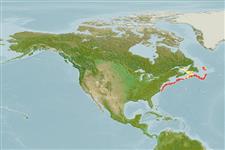
marino batidemersal; rango de profundidad 400 - 2000 m (Ref. 50674). Deep-water; 50°N - 35°N, 76°W - 48°W
Northwest Atlantic: Nova Scotia and Hudson Canyon (Ref. 37108). Southwest Pacific: Australia (Ref. 75154).
Tamaño / Peso / Edad
Madurez: Lm ? range ? - ? cm
Max length : 50.0 cm TL macho / no sexado; (Ref. 11041)
Descripción breve
Claves de identificación | Morfología | Morfometría
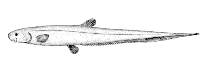
Espinas dorsales (total) : 6 - 8; Radios blandos dorsales (total) : 4 - 5; Espinas anales: 44 - 58; Radios blandos anales: 67 - 88; Vértebra: 228 - 234. Tail slender and tapering to a point. Mouth inferior, small and sucker-like; upper lip with thick, pleated folds; posterior end of maxilla bent sharply downward, forming a flap-like structure; fleshy papillae on snout bordering upper lip. Teeth absent. Dorsal fin short-based, located above anus, the first 4-6 rays hard and spinous, increasing in length from front to back, the remainder soft and segmented, membrane connecting all rays except for first I-III spines. Anal fin long, extending from just behind anus to tip of tail, anterior rays spinous, posterior rays segmented, the transition gradual. Caudal fin absent (Ref. 11041). Light brown, lining of gill chamber and rim of opercular branchiostegal flap dark brown, mouth and lining of buccal cavity light yellowish tan (Ref. 37108).
Body shape (shape guide): elongated; Cross section: circular.
Feed mostly on organic material contained in bottom sediment drawn up by the sucker-like mouth [RF doubts this is a detritus feeder; the elaborate mouth without teeth looks like a specialization for extracting soft-bodied benthic invertebrates out of the ground; also, there are no gill rakers to filter detritus (Ref. 50674)]. No obvious sexual dimorphism; a female of 37.5 cm SL was still immature (Ref. 50674).
Ciclo vital y comportamiento de apareamiento
Madurez | Reproducción | Puesta | Huevos | Fecundidad | Larva
Sexes can be separated by testis and ovaries; there is no indication of internal fertilization.
Smith, D.G., 1997. Lipogenyidae. Spiny sucker eels. p. 1629. In K.E. Carpenter and V.H. Niem (eds.) FAO species identification guide for fishery purposes. The living marine resources of the WCP. Vol. 3. Batoid fishes, chimaeras and bony fishes part 1 (Elopidae to Linophrynidae). FAO, Rome. (Ref. 11041)
Situación en la Lista Roja de la UICN (Ref. 130435: Version 2025-2 (Global))
Amenaza para el ser humano
Harmless
Usos humanos
Pesquerías: sin interés
Herramientas
Informes especiales
Descargar XML
Fuentes de Internet
Estimaciones basadas en modelos
Temperatura preferida (Referencia
123201): 3.4 - 5.3, mean 3.9 °C (based on 17 cells).
Índice de diversidad filogenética (Referencia
82804): PD
50 = 0.7501 [Uniqueness, from 0.5 = low to 2.0 = high].
Bayesian length-weight: a=0.00257 (0.00104 - 0.00637), b=3.09 (2.88 - 3.30), in cm total length, based on LWR estimates for this (Sub)family-body shape (Ref.
93245).
Nivel trófico (Referencia
69278): 3.5 ±0.37 se; based on food items.
Resiliencia (Referencia
120179): Bajo, población duplicada en un tiempo mínimo de 4.5-14 años (Assuming tm >=5).
Vulnerabilidad pesquera (Ref.
59153): Moderate vulnerability (40 of 100).
🛈