>
Notacanthiformes (Halosaurs and deep-sea spiny eels) >
Notacanthidae (Deep-sea spiny eels)
Etymology: Lipogenys: Greek, lipos = fat + Greek, geny, -yos = face, jaw (Ref. 45335).
Eponymy: Professor Theodore Nicholas Gill (1837–1914) was an American ichthyologist, malacologist, mammologist and librarian, a zoologist at George Washington University and associated with the Smithsonian Institution for more than half a century. [...] (Ref. 128868), visit book page.
More on authors: Goode & Bean.
Ambiente: milieu / zona climatica / distribuzione batimetrica / gamma di distribuzione
Ecologia
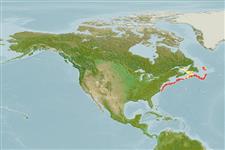
marino batidemersale; distribuzione batimetrica 400 - 2000 m (Ref. 50674). Deep-water; 50°N - 35°N, 76°W - 48°W
Northwest Atlantic: Nova Scotia and Hudson Canyon (Ref. 37108). Southwest Pacific: Australia (Ref. 75154).
Dimensione / Peso / Età
Maturità: Lm ? range ? - ? cm
Max length : 50.0 cm TL maschio/sesso non determinato; (Ref. 11041)
Breve descrizione
Chiavi di identificazione | Morfologia | Morfometria
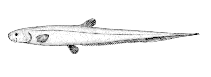
Spine dorsali (totale) : 6 - 8; Raggi dorsali molli (totale) : 4 - 5; Spine anali: 44 - 58; Raggi anali molli: 67 - 88; Vertebre: 228 - 234. Tail slender and tapering to a point. Mouth inferior, small and sucker-like; upper lip with thick, pleated folds; posterior end of maxilla bent sharply downward, forming a flap-like structure; fleshy papillae on snout bordering upper lip. Teeth absent. Dorsal fin short-based, located above anus, the first 4-6 rays hard and spinous, increasing in length from front to back, the remainder soft and segmented, membrane connecting all rays except for first I-III spines. Anal fin long, extending from just behind anus to tip of tail, anterior rays spinous, posterior rays segmented, the transition gradual. Caudal fin absent (Ref. 11041). Light brown, lining of gill chamber and rim of opercular branchiostegal flap dark brown, mouth and lining of buccal cavity light yellowish tan (Ref. 37108).
Body shape (shape guide): elongated; Cross section: circular.
Feed mostly on organic material contained in bottom sediment drawn up by the sucker-like mouth [RF doubts this is a detritus feeder; the elaborate mouth without teeth looks like a specialization for extracting soft-bodied benthic invertebrates out of the ground; also, there are no gill rakers to filter detritus (Ref. 50674)]. No obvious sexual dimorphism; a female of 37.5 cm SL was still immature (Ref. 50674).
Ciclo vitale e comportamento di accoppiamento
Maturità | Riproduzione | Deposizione | Uova | Fecondità | Larve
Sexes can be separated by testis and ovaries; there is no indication of internal fertilization.
Smith, D.G., 1997. Lipogenyidae. Spiny sucker eels. p. 1629. In K.E. Carpenter and V.H. Niem (eds.) FAO species identification guide for fishery purposes. The living marine resources of the WCP. Vol. 3. Batoid fishes, chimaeras and bony fishes part 1 (Elopidae to Linophrynidae). FAO, Rome. (Ref. 11041)
Stato della Lista Rossa IUCN (Ref. 130435: Version 2025-2 (Global))
Minaccia per l'uomo
Harmless
Usi umani
Pesca: di nessun interesse
Strumenti
Rapporti speciali
Scarica XML
Fonti Internet
Stime basate su modelli
Temperatura preferita (Fonte Biblio.
123201): 3.4 - 5.3, mean 3.9 °C (based on 17 cells).
Indice di diversità filogenetica (Fonte Biblio.
82804): PD
50 = 0.7501 [Uniqueness, from 0.5 = low to 2.0 = high].
Bayesian length-weight: a=0.00257 (0.00104 - 0.00637), b=3.09 (2.88 - 3.30), in cm total length, based on LWR estimates for this (Sub)family-body shape (Ref.
93245).
Livello trofico (Fonte Biblio.
69278): 3.5 ±0.37 se; based on food items.
Resilienza (Fonte Biblio.
120179): Basso, tempo minimo di raddoppiamento della popolazione 4.5 - 14 anni (Assuming tm >=5).
Vulnerabilità della pesca (Ref.
59153): Moderate vulnerability (40 of 100).
🛈