>
Blenniiformes (Blennies) >
Blenniidae (Combtooth blennies) > Salariinae
Etymology: Cirripectes: Latin, cirrus = curl fringe + Greek, pektos, -e, -on = made of several parts solidly united (Ref. 45335); castaneus: Specific epithet 'castaneus' meaning brown or the color of chestnuts, presumably referring to the color of the holotype in alcohol.
More on author: Valenciennes.
Environnement : milieu / zone climatique / profondeur / gamme de distribution
Écologie
marin; saumâtre récifal; profondeur 0 - 32 m (Ref. 529), usually 0 - 10 m (Ref. 529). Tropical; 35°N - 35°S
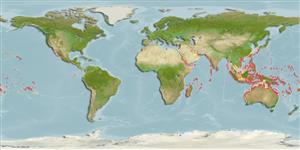
Indo-West Pacific: Red Sea to Tonga, north to southern Japan; south to Lord Howe Island; Palau, Ifaluk, and Kapingamarangi in Micronesia.
Longueur à la première maturité / Taille / Poids / Âge
Maturité: Lm ?, range 4 - ? cm
Max length : 9.2 cm SL mâle / non sexé; (Ref. 529)
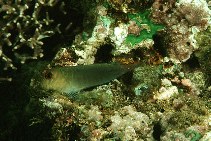
Épines dorsales (Total) : 11 - 13; Rayons mous dorsaux (Total) : 13 - 15; Épines anales: 2; Rayons mous anaux: 14 - 16; Vertèbres: 29 - 31. Diagnosis: Dorsal fin XII, 14, membrane attached to caudal fin, with deep notch above last spine, first spine almost same or slightly higher than second; anal fin II, 15; pectoral rays 15; pelvic fin I, 4; caudal fin procurrent rays 10-14. Vertebrae 11 + 20. Body depth at anal-fin origin 3.2-3.5 in SL. Body depth at anal-fin origin 3.2-3.7 in SL. LL, without scales and scalelike flaps; LL tubes 1-13 (usually 3-12), canal ends below 5th dorsal ray to caudal-fin base. Lower lip smooth mesially, plicate laterally. Upper lip crenulae 29-50. Gill rakers 20-32. Cephalic sensory pore system simple; 1 pore behind each nuchal flap. Cirri, nuchal 29-44, nasal 6-49, supraorbital 6-49; nuchal cirri in 4 groups, ventralmost group on each side borne on slightly expanded nuchal flap. Meristic and morphological characters consistent; color pattern geographically variable. Males: Chagos, body bars alternating light and dark brown, dorsal spine tips and anterior caudal fin rays yellow; Red Sea, head and anterior body bars narrow red on brown background; GBR, head and body bars alternating pink and brown; Fiji, body bars brown on grey or yellow background; Comoros, bars reddish brown, slightly oblique. Females: mostly with reticulated pattern of wavy brown lines and pale polygonal spots; others plain brown, particularly those from South Africa and Kenya Head with spots and lines; iris with irregular red ring around outer part of eye, narrow yellow ring around pupil, with black between the ring (Ref. 529, 90102).
Body shape (shape guide): elongated; Cross section: oval.
Facultative air-breathing (Ref. 126274); Adults occur in wave-swept algal ridge (Porolithon ridge) of outer reef flats. Usually found on rocky and coralline substrates at depths less than 10 m. Usually seen in small loose groups spread over sections of reef (Ref. 48636). Oviparous. Eggs are demersal and adhesive (Ref. 205), and are attached to the substrate via a filamentous, adhesive pad or pedestal (Ref. 94114). Larvae are planktonic, often found in shallow, coastal waters (Ref. 94114). Have been collected as deep as 30 m in the Red Sea, 32 m at Rowley Shoals off Western Australia (Ref. 529).
Cycle de vie et comportement reproducteur
Maturité | Reproduction | Frai | Œufs | Fécondité | Larves
Oviparous, distinct pairing (Ref. 205). Urogenital orifice of male genital papilla located basally between 2 widely separated slender filaments on a fleshy swelling behind anus; testes bulbous with length equal to its width (Ref. 529).
Williams, J.T., 1988. Revision and phylogenetic relationships of the blenniid fish genus Cirripectes. Indo-Pac. Fish. (17):78 p. (Ref. 529)
Statut dans la liste rouge de l'IUCN (Ref. 130435: Version 2025-2 (Global))
Menace pour l'homme
Harmless
Utilisations par l'homme
Pêcheries: commercial; Aquarium: Commercial
Outils
Articles particuliers
Télécharger en XML
Sources Internet
Estimations basées sur des modèles
Température préférée (Réf.
123201): 24.3 - 29.3, mean 28.2 °C (based on 3175 cells).
Indice de diversité phylogénétique (Réf.
82804): PD
50 = 0.5000 [Uniqueness, from 0.5 = low to 2.0 = high].
Bayesian length-weight: a=0.00955 (0.00517 - 0.01764), b=3.03 (2.87 - 3.19), in cm total length, based on LWR estimates for this species & (Sub)family-body (Ref.
93245).
Niveau trophique (Réf.
69278): 2.0 ±0.00 se; based on food items.
Résilience (Réf.
120179): Haut, temps minimum de doublement de population inférieur à 15 mois (Preliminary K or Fecundity.).
Vulnérabilité de la pêche (Ref.
59153): Low vulnerability (10 of 100).
🛈
Nutriments (Ref.
124155): Calcium = 153 [69, 272] mg/100g; Iron = 0.805 [0.447, 1.480] mg/100g; Protein = 18 [17, 19] %; Omega3 = 0.0977 [, ] g/100g; Selenium = 25.1 [10.8, 63.9] μg/100g; VitaminA = 115 [30, 446] μg/100g; Zinc = 3.04 [1.93, 4.68] mg/100g (wet weight);