Milieu: milieu / Klimaatzone / Diepte / verspreidingsgebied
Ecologie
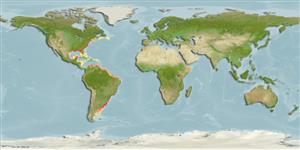
marien; brak water demersaal; oceanodroom (Ref. 51243); diepte 10 - ? m. Subtropical; 46°N - 51°S
Western Atlantic: Nova Scotia (Ref. 7251) to Florida, Gulf of Mexico, the Antilles (uncommon), and the southern Caribbean coast; also from the Orinoco delta to Argentina.
Lengte bij maturiteit / Grootte / Gewicht / Leeftijd
Maturiteit: Lm 64.5, range 63 - ? cm
Max length : 170 cm TL mannelijk / geslacht onbekend; (Ref. 7251); common length : 50.0 cm TL mannelijk / geslacht onbekend; (Ref. 3702); max. gepubliceerd gewicht: 51.3 kg (Ref. 4699); max. gerapporteerde leeftijd: 43 Jaren (Ref. 7188)
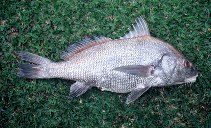
Dorsale stekels (totaal) : 11; Dorsale zachte stralen (totaal) : 19 - 22; Anale stekels: 2; Anale zachte stralen: 5 - 7. Silvery grey to very dark, young with 4 or 5 black vertical bars on sides, disappearing with growth; pelvic and anal fins usually dark. Chin with 5 pores and 10 to 13 pairs of small barbels along median edges of lower jaws and subopercles, increasing in length posteriorly. Gas bladder with numerous lateral appendages interconnected in a complicated pattern in adult. Sagitta semicircular and moderately thin (Ref 51721).
Body shape (shape guide): fusiform / normal.
Found usually over sand and sandy mud bottoms in coastal waters, especially in areas with large river runoffs. Juveniles often enter estuaries. Feeds mainly on crustaceans, mollusks and fishes.
Robins, C.R. and G.C. Ray, 1986. A field guide to Atlantic coast fishes of North America. Houghton Mifflin Company, Boston, U.S.A. 354 p. (Ref. 7251)
Status op de Rode Lijst van het IUCN (Ref. 130435: Version 2025-2 (Global))
Gevaar voor de mens
Harmless
Gebruik door de mens
Visserij: commercieel; sportvis: ja; Aquarium: Publieke aquaria
Tools
Speciale rapporten
Download XML
Internetbronnen
Schattingen op basis van modellen
Gewenste temperatuur (Ref.
123201): 10.8 - 27.6, mean 23.5 °C (based on 326 cells).
Fylogenetische diversiteitsindex (Ref.
82804): PD
50 = 1.0000 [Uniqueness, from 0.5 = low to 2.0 = high].
Bayesian length-weight: a=0.00851 (0.00776 - 0.00934), b=3.07 (3.04 - 3.10), in cm total length, based on LWR estimates for this species (Ref.
93245).
Trofisch niveau (Ref.
69278): 3.4 ±0.5 se; based on diet studies.
Weerstandsvermogen (Ref.
120179): Gemiddeld, minimale populatieverdubbelingstijd 1,4-4,4 jaar (K=0.17; tm=3-5; tmax=43).
Kwetsbaarheid van de visserij (Ref.
59153): High vulnerability (60 of 100).
🛈
Kwetsbaarheid voor het klimaat (Ref.
125649): Moderate to high vulnerability (54 of 100).
🛈
Voedingsstoffen (Ref.
124155): Calcium = 38.1 [22.4, 72.3] mg/100g; Iron = 0.803 [0.422, 1.361] mg/100g; Protein = 19.7 [18.0, 21.7] %; Omega3 = 0.289 [0.175, 0.459] g/100g; Selenium = 37.5 [20.9, 71.1] μg/100g; VitaminA = 4.98 [1.88, 15.13] μg/100g; Zinc = 0.611 [0.443, 0.888] mg/100g (wet weight); based on
nutrient studies.