>
Perciformes/Cottoidei (Sculpins) >
Cottidae (Sculpins)
Etymology: Triglops: Greek, trigla, es = red mullet + greek, ops = appearance (Ref. 45335).
Eponymy: Sir John Murray (1841–1914) was a Canadian marine naturalist often described as the founder of modern oceanography. [...] (Ref. 128868), visit book page.
More on author: Günther.
Umwelt: Milieu / Klimazone / Tiefenbereich / Verbreitungsgebiet
Ökologie
seewasser demersal; standorttreu; tiefenbereich 7 - 530 m (Ref. 58496). Temperate; 0°C - 12°C (Ref. 35388); 79°N - 41°N, 95°W - 45°E
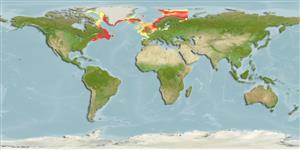
North Atlantic: Cape Cod on the American coast northward to Ungava Bay, Greenland, Iceland, and the Atlantic coast of northern Europe.
Größe / Gewicht / Alter
Geschlechtsreife: Lm ? range ? - ? cm
Max length : 20.0 cm SL Männchen/unbestimmt; (Ref. 7297); 15.9 cm SL (female)
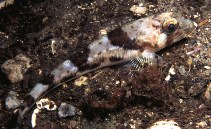
Dark spot in the hind part of first dorsal fin, caudal fin with dark stripes. Series of skin folds with serrated edges running obliquely down below the lateral line (Ref. 35388).
Body shape (shape guide): elongated.
Maximum depth reported at 530 m (Ref. 58426). In the Barents Sea usually between 100 to 200 m at temperatures of 1°-3°C and salinities not less than 34 ppt; in the White Sea in somewhat shallower waters at temperatures between 6-12°C and salinities of 23-29 ppt. Prefers sandy bottoms (Ref. 7297). Benthic to epibenthic (Ref. 58426). Feeds on polychaetes and crustaceans (Ref. 35388).
Lebenszyklus und Paarungsverhalten
Geschlechtsreife | Fortpflanzung | Ablaichen | Eier | Fruchtbarkeit | Larven
Pietsch, T.W., 1993. Systematics and distribution of cottid fishes of the genus Triglops Reinhardt (Teleostei: Scorpaeniformes). Zool. J. Linn. Soc. 109:335-393. (Ref. 7297)
IUCN Rote Liste Status (Ref. 130435: Version 2025-2 (Global))
Bedrohung für Menschen
Harmless
Nutzung durch Menschen
Fischereien: nicht kommerziell
Tools
Zusatzinformationen
Download XML
Internet Quellen
Schätzungen auf der Grundlage von Modellen
Bevorzugte Temperatur (Ref.
123201): 0.5 - 8, mean 4.2 °C (based on 699 cells).
Phylogenetischer Diversitätsindex (Ref.
82804): PD
50 = 0.5010 [Uniqueness, from 0.5 = low to 2.0 = high].
Bayesian length-weight: a=0.00603 (0.00290 - 0.01252), b=3.14 (2.96 - 3.32), in cm total length, based on LWR estimates for this (Sub)family-body shape (Ref.
93245).
Trophische Ebene (Ref.
69278): 3.5 ±0.5 se; based on diet studies.
Widerstandsfähigkeit (Ref.
120179): niedrig, Verdopplung der Population dauert 4,5 - 14 Jahre. (Fec=100).
Anfälligkeit der Fischerei (Ref.
59153): Moderate vulnerability (39 of 100).
🛈
Nährstoffe (Ref.
124155): Calcium = 85.8 [35.9, 190.5] mg/100g; Iron = 0.423 [0.197, 0.939] mg/100g; Protein = 17.3 [15.2, 19.5] %; Omega3 = 0.751 [0.319, 2.155] g/100g; Selenium = 18.5 [8.7, 45.3] μg/100g; VitaminA = 18.5 [5.2, 62.4] μg/100g; Zinc = 0.697 [0.454, 1.197] mg/100g (wet weight);