>
Perciformes/Cottoidei (Sculpins) >
Cottidae (Sculpins)
Etymology: Leptocottus: Greek, leptos = thin + Greek, kottos = a fish (Ref. 45335); armatus: Leptocottus meaning slender Cottus; armatus armed, referrign to the sharp preopercular spines (Ref. 4930).
More on author: Girard.
Umwelt: Milieu / Klimazone / Tiefenbereich / Verbreitungsgebiet
Ökologie
seewasser; brackwasser demersal; amphidrom (Ref. 51243); tiefenbereich 0 - 156 m. Temperate; 60°N - 33°N
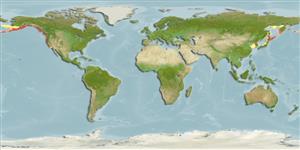
Eastern Pacific: Izembek Lagoon, on the southeastern Bering Sea coast of Alaska to Bahia San Quintin, northern Baja California, Mexico.
Größe / Gewicht / Alter
Geschlechtsreife: Lm ? range ? - ? cm
Max length : 46.0 cm TL Männchen/unbestimmt; (Ref. 2850); common length : 35.5 cm TL Männchen/unbestimmt; (Ref. 12193); max. veröff. Alter: 10 Jahre (Ref. 28936)
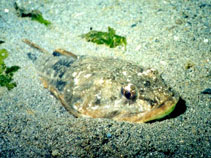
Rückenflossenstacheln (insgesamt) : 6 - 8; Rückenflossenweichstrahlen (insgesamt) : 15 - 20; Afterflossenstacheln: 0; Afterflossenweichstrahlen: 15 - 20; Wirbelzahl: 37 - 39. Distinguished by the large upper preopercular spine ending in 3 or 4 sharp, upturned, curved spinules and by the large, dark spot on the posterior part of the spiny dorsal fin (Ref. 27547). Gill rakers reduced to flat, bony plates, each bearing a cluster of small teeth; lateral line nearly straight; each pore associated with a small subdermal cartilaginous plate (Ref. 27547). Caudal rounded (Ref. 6885). Grayish olive to rather green, occasionally with some yellow, dorsally; orange-yellow to white or silvery below lateral line; spiny dorsal dusky, with a black spot near tips of last 3 spines, a white band below it; soft dorsal fin dusky, with several oblique white to yellowish bands; pectorals yellow with 5 or 6 dark greenish bars; caudal dusky with one or two pale bands; anal and pelvic fins pale (Ref. 27547).
Body shape (shape guide): elongated.
Commonly found near shore, especially in bays and estuaries; most frequently on sandy bottom (Ref. 2850). Intertidal individuals breath air when out of water (Ref. 31184). Can leave tide pools if aquatic conditions become inhospitable (Ref. 31184). Although some individuals may spend their entire life in highly saline waters (Ref. 28693), some newly metamorphosed young move from the estuarine spawning sites to completely fresh water and may remain there for up to 6 weeks (Ref. 27547). Adults apparently tend to remain in the shallow lower estuary, or farther offshore (Ref. 27547). Feeds mostly on crabs, shrimps and amphipods, but also takes larval, juvenile and adult fishes, as well as polychaete worms, mollusks and other invertebrates (Ref. 4930). Expands its gill covers and produces a low-pitched humming sound when stressed (Ref. 6885). Considered a nuisance by anglers (Ref. 27547).
Eschmeyer, W.N., E.S. Herald and H. Hammann, 1983. A field guide to Pacific coast fishes of North America. Boston (MA, USA): Houghton Mifflin Company. xii+336 p. (Ref. 2850)
IUCN Rote Liste Status (Ref. 130435: Version 2025-2 (Global))
Bedrohung für Menschen
Harmless
Nutzung durch Menschen
Fischereien: kommerziell; Aquarium: Öffentliche Aquarien
Tools
Zusatzinformationen
Download XML
Internet Quellen
Schätzungen auf der Grundlage von Modellen
Bevorzugte Temperatur (Ref.
123201): 4.5 - 14.1, mean 8.7 °C (based on 352 cells).
Phylogenetischer Diversitätsindex (Ref.
82804): PD
50 = 1.0000 [Uniqueness, from 0.5 = low to 2.0 = high].
Bayesian length-weight: a=0.01072 (0.00599 - 0.01918), b=3.18 (3.02 - 3.34), in cm total length, based on LWR estimates for this species & (Sub)family-body (Ref.
93245).
Trophische Ebene (Ref.
69278): 3.7 ±0.64 se; based on food items.
Widerstandsfähigkeit (Ref.
120179): mittel, Verdopplung der Population dauert 1,4 - 4,4 Jahre. (tm=1; tmax=10).
Anfälligkeit der Fischerei (Ref.
59153): Moderate vulnerability (36 of 100).
🛈
Nährstoffe (Ref.
124155): Calcium = 66.7 [29.5, 146.1] mg/100g; Iron = 0.418 [0.197, 0.881] mg/100g; Protein = 18.1 [16.0, 20.3] %; Omega3 = 0.668 [0.293, 1.935] g/100g; Selenium = 18.9 [8.9, 45.8] μg/100g; VitaminA = 8.11 [2.78, 24.42] μg/100g; Zinc = 0.618 [0.413, 1.057] mg/100g (wet weight);